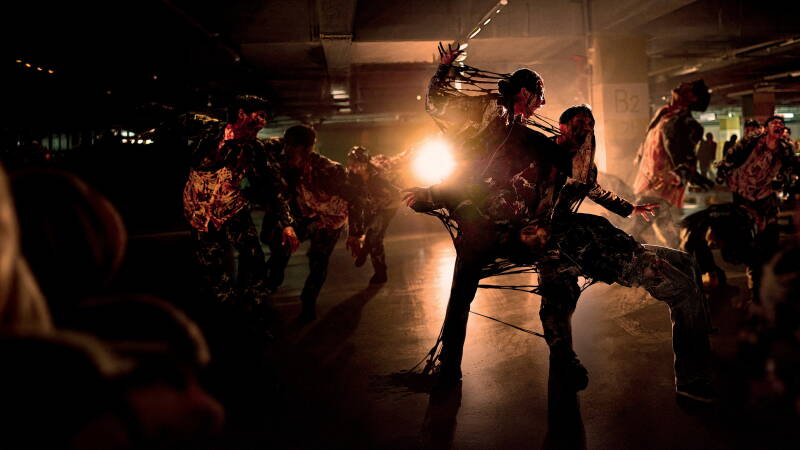
An insect colony does not operate through malice; it operates through purpose, bound together by an invisible network of pheromones where individual self-preservation is completely erased in service of the swarm. In Yeon Sang-ho’s "Colony," this biological inevitability becomes the central architecture of dread. Trapped inside the clinical, claustrophobic confines of a sealed biotech complex, human beings are forced to confront an infection that strips away the soul not merely to create mindless predators, but to form a singular, hyper-coordinated hive mind. The terror here is not just the threat of being torn apart by flesh-eaters; it's the chilling realization that the horde hunting you thinks with one brain, moves with one absolute will, and responds seamlessly to an overarching command.
For Yeon, whose career post-Train to Busan took a staggering detour into the bloated, green-screen spectacle of Peninsula, Colony represents a crucial and welcome recalibration. Abandoning the hollow CGI excess that diluted his earlier sequel, Yeon grounds this nightmare in tangible, suffocating reality. The film relies heavily on punishing practical effects and intricate physical choreography to depict a rapidly mutating virus, giving every bite, tear, and bone-snapping transformation a visceral, wet immediacy. The enclosed facility acts as a pressure cooker, transforming pristine corporate corridors into a maze of rusted blood and shattered glass, where every corner turned carries the threat of an entire swarm shifting in unison.
At the center of this biological siege is a genuinely sinister antagonist, a figure whose calculated cruelty elevates the film above standard survival cinema. Rather than treating the outbreak as a tragedy to be contained, this mastermind weaponizes the hive structure itself, dictating the movements of the infected like pieces on a chessboard. It shifts the narrative momentum from simple escape to a high-stakes battle of wits against a villain who controls the entire ecosystem. The screenplay uses this ant-like hive dynamic to construct remarkably clever set pieces: a single survivor’s whisper can trigger a silent, synchronized turn of a hundred heads, and the horde’s collective problem-solving forces the human characters to constantly adapt their strategies just to stay breathing.
While "Colony" does not quite scale the emotional, tear-soaked peaks of Train to Busan, it stands as a sleek, highly intelligent, and unapologetically bloody return to form for its director. By infusing a tired subgenre with fresh entomological terror and refusing to skimp on the practical gore, Yeon proves that there is still life—and terrifying intelligence—left in the walking dead.
8/10
Add comment
Comments