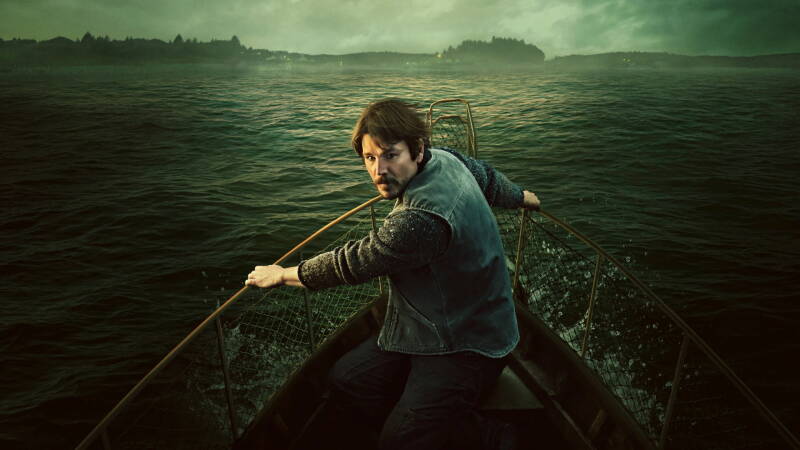
Water remembers what we try to drown, and in the jagged, salt-bitten coves of Newfoundland, it spits those memories back up as cosmic nightmares. For its initial three hours, Jesse McKeown’s limited series Below understands this primal dread with terrifying precision, establishing a suffocating atmosphere where the Atlantic is not merely an expanse of water, but an ancient, watching adversary. It lures the viewer into a deep-sea trance, sketching a portrait of a small, isolated fishing community burdened by economic decay and generational ghosts. Yet, television has a historic cowardice when confronted with true darkness, frequently lacking the stomach to sustain its own horror, and Below ultimately falls victim to this very identity crisis, executing a narrative U-turn that converts a promised masterpiece of cosmic horror into a sunlit, placid fable.
The early movements of the series are nothing short of hypnotic. Josh Hartnett’s Calvin Penney—a weathered fisherman convinced he is bound by a lifelong family curse following a childhood tragedy on the abandoned island of Little Pot Rock—anchors the human cost of living at the edge of the world. Beside him, Charlie Heaton’s Wade drifts through a haze of arrested development, his skin bearing the physical stigmata of an invisible encounter, haunted by waking nightmares of local folklore and the crushing weight of an unnameable presence beneath the surface. When an imposing, anomalous iceberg appears in the harbor—mistaken at first for a stroke of economic fortune—it arrives with the silent, alien geometry of a Lovecraftian monolith. The air grows heavy with the scent of brine and impending madness; townsfolk experience an unquenchable thirst and a terrifying, magnetic compulsion to walk into the black water. It's a well orchestrated lesson in slow-burn tension, evoking the creeping dread of an ecosystem turning hostile against its inhabitants.
The tragedy of the series lies in how thoroughly it dismantles its own architecture precisely at the halfway mark. The colossal cephalopod, introduced with the mythic fury of a modern-day Kraken that bends human psychology and spawns hallucinatory visions, is systematically defanged. What begins as a terrifying interrogation of the unknown—a dark entity echoing ancestral sins and childhood loss—collapses into a mundane exercise in wildlife conservation. The monstrous abyss of the ocean is reduced to a misunderstood mother protecting her young, rendering the haunting historical scars of Calvin’s past and the eerie, psychological disintegration of Wade narratively mute. The iceberg, laden with the heavy promise of cosmic secrets and ancient, non-human intent, dissolves into narrative insignificance, leaving behind a vacuum where atmosphere once reigned.
It's a rare and frustrating inversion of genre mechanics: a horror story that runs away from the dark and scrambles desperately toward the light. By opting for a gentle, emotionally tidy resolution that wraps its trauma in a forgiving blanket of absolution, the series betrays the very isolation that gave it life. The rich, melancholic texture of the Newfoundland coast, captured so brilliantly in the opening acts, feels ultimately wasted on a narrative that loses its nerve. We are left mourning not just the fictional town's struggles, but the ghost of a truly great thriller that drowned in shallow water.
6/10
Add comment
Comments