Ralph White spent years bracing for the end of the world, stocking his fear like a pantry and scanning the horizon for the conspiracy that would come for him. Then a block of concrete fell on him at a construction site and the end of the world carried on without him. It's a darkly funny way into Mike Flanagan's Carrie, and the joke has teeth. The apocalypse Ralph dreaded never turns up in the shape he imagined. Turns out he spent all that time waiting for the end of the world at the hands of the government, when the apocalypse was sat in the next room reading or repenting. Carrie is the end of the world. The digital landscape, the modern world of bullying, and her mother's scripture are only instruments, each pulling a little tighter on something already wound to snap. Ralph was right that something was coming. He just never thought to check under his own roof.
Carrie is no stranger to fear. She has flinched her whole life, except that the raised hand was her mother's and the name invoked was God's. What she hasn't had is the world. She has lived among a few walls, her books and a catechism, so she is innocent in the way a bright, thoughtful, almost ferociously sincere person is when nobody has ever shown her what people are capable of. She walks into school for the first time with a target on her back that everyone can see except her. When the cruelty comes she doesn't read it as cruelty. She keeps hunting for the misunderstanding, because she wants to believe everyone is as considerate as she is. That sincerity is the cruellest thing the series does to her. She isn't a wounded animal waiting to go off. She's someone trusting the room right up until the room proves itself unworthy.
The architect of that trust is also its first vandal. Samantha Sloyan's Margaret is not the howling zealot Piper Laurie gave the 1976 film, and she's all the more frightening for it. She's patient and tidy, and she's very good at withholding. She keeps from her daughter what a period is and what the internet does, and she calls the ignorance protection. Her daughter is never allowed to be a person, only a project she can manage, which is why Carrie's eventual explosion feels so thoroughly like a failure of parenting rather than a failure of character.
Margaret has spent a lifetime being the bully in the house and has never once noticed. Her weapon is God, and Flanagan, who keeps returning to faith as the place people hide, uses it with the same cold eye he brought to Midnight Mass. Whenever Carrie catches her mother lying or asks a question with an inconvenient answer, scripture drops like a shutter, and the child is made to repent for being right. It's an armour that works only as long as the person inside it believes the voice behind it is bigger than the child's own. The series asks what's left of Margaret when that voice goes quiet, and the answer, delivered late and without mercy, is not flattering.
Everything Carrie knows about people she has learned from one stern voice and a shelf of books, and the series understands what that does to a mind. A girl raised on scripture and novels walks into the world expecting its inhabitants to behave like characters: to have reasons, to mean what they say, to arrive eventually at some version of kindness. She isn’t armoured by suspicion, because suspicion is what you collect from being hurt by strangers, and no stranger has ever been allowed near her. So when she steps through the doors of a school for the first time, she carries the one thing the place has no use for, a willingness to think well of everyone in it.
What happens in the locker room on the poor girls first day is less an ambush than a correction of that belief, delivered in the most public, soul destroying manner available. Carrie, who has never been told what is happening to her own body, is on her hands and knees in the girls showers while they stand there laughing, and throwing tampons and pads at her. But it doesn't stop there, because the whole event gets recorded. In 1976 the humiliation ended when the water stopped. Here, courtesy of technology, that was just the beginning. The real slow releasing trauma starts once somebody hits upload—Carrie will now spend the rest of the series being made to relive the worst moment of her life by people she has never met, on screens she barely understands. Yet she still trusts and has faith in her fellow students.
Something the series often returns to is Carrie's faith, and I don't mean the one her mother taught her. She has known fear, but only the household kind, delivered in the name of God by the woman who raised her. Nothing in that upbringing has convinced her that people are hard-hearted. She still walks into that school believing everyone is capable of kindness and that the worst of them can be coerced by kindness. So when people apologise and say they're sorry, she accepts it as true. Why wouldn't she? Doubting an apology requires being able to picture someone apologising as a performance, and Carrie can't picture it. She doesn't know that people can carry that streak of cruelty and set it down just long enough to get what they want. Her trust is no naivety. It comes from a generosity so complete that it can't imagine a motive it doesn't share, and the series is shrewd enough to see that this is far harder to protect than ignorance. It's agonising to watch, and not because the writing is manipulative. It's hard because everything good in her, the gentleness, the wish to be liked, the refusal to assume bad intent, becomes the mechanism of her undoing. Her sincerity is the handle by which people pick her up.
Trust is a fine thing to carry into a room full of friends. It is a poor defence against something that doesn't need her in the room at all. While Carrie is busy believing in the better nature of the people around her, her worst moment is somewhere she can't follow, being watched by strangers, and what she's up against is no longer a few girls with a grudge. It's an audience, and an audience doesn't need a reason. Nobody has to decide to be cruel. All it takes is a share, a laugh, a comment, each small enough that whoever supplies it can tell themselves they did nothing, and the harm collects in the gaps between those harmless-looking gestures until it has the weight to flatten a person.
What the series understands, and what I found hardest to sit through, is how quickly a crowd stops asking whether any of it is fair. The footage acquires a name, the name becomes a joke, the joke becomes a habit a whole building can gather round, and somewhere along that road the girl at the centre stops being a person and turns into a shared reference. Blame wants somewhere to land, and the easiest place has always been whoever is least able to answer back. The adults, who are meant to be the safeguard, mostly stand at the edge of it, admitting the thing moves faster than they can follow. Nor does the show hand us a single villain to hate on everyone else's behalf. Chris is cruel and isn't excused for it, and Sue's conscience is real, but the true horror is the arithmetic: a person can be taken apart by a community without any one member of it feeling responsible for the result.
I grew up at the tail end of an era when this kind of misery still had edges. A bully needed a face, an address and the nerve to turn up, and whatever followed, a scuffle, some shouting over a garden wall, a few lads loitering outside to goad you out, was physical, local, and finished by teatime. Nobody thought to film it. Nobody thought to post it. You went indoors, shut your bedroom door, and the world stayed on the other side of it. That door is what the series takes from Carrie, and from every child watching. Her room now holds a device, the device holds an audience, and the audience can reach the one place she might otherwise have been alone. Nothing is thrown and nobody is bruised, yet someone is being taken apart from the inside, their idea of who they are slowly overwritten by other people's. I had to pause it more than once, and I'm not embarrassed to say so. Part of what made it harder was knowing how little can be done. So much of it happens behind anonymous accounts that schools and the law are left with their hands open, and it so often takes a catastrophe before anyone is permitted to act. The series knows that, and it makes you sit in the waiting.
Which is why Margaret's failure stings more the longer it runs. Somewhere in that house was the one adult who might have given Carrie a map to life like any good parent would. She gave her scripture instead and called the gap protection. I keep returning to how simple the alternative was. Being honest with a child costs something, and it can be awkward, frightening and slow, but it is the job. Nobody asks to be born. Whatever we believe about religion, work or our own convictions, they come second to the unwritten bargain that says we brought you here, so we will be there when it gets hard. That goes for parents, and equally for teachers, aunts, uncles and anyone else a young person might one day turn to. Life makes it difficult, and the systems around us can feel insurmountable, but we only get one go round with the people we're responsible for. Margaret had hers and spent it on control, and the series lets you feel the bill arriving.
It isn't flawless, and I won't pretend it frightened me the way The Haunting of Hill House did. This is a tragedy in a horror coat, and it earns its dread through sorrow rather than shock, which will disappoint anyone who came for the jump.
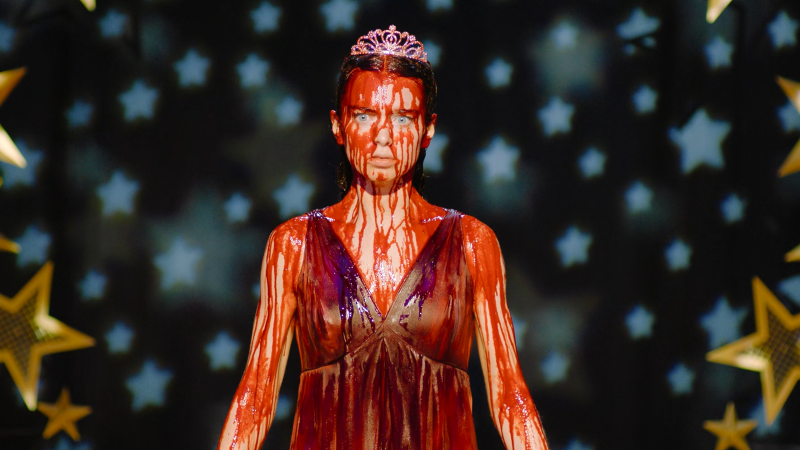
Whatever reservations I have about the sprawl, they fall quiet once the series reaches the prom, because by then it has done something patient and rather cruel: it has let us hope. In the hours leading up to it, the world around Carrie softens by degrees, so slowly that you hardly register it happening, until you realise you've started to believe she might be allowed one good night. Then the invitation comes. The most handsome boy in the school asks her to the prom, and he asks with good intentions, with no wager behind it and no joke waiting at the end of it. That sincerity on his side is what makes it so painful to watch her receive it. She says yes the way she has said yes to everything, with her whole trusting heart, and she arrives at the evening carrying the same innocence she carried through the school doors on her first morning, as though nothing done to her could have been enough to teach her otherwise. I wanted to reach through the screen and tell her to stay home, and I wanted just as badly to watch her have it, and the series holds you in that exact split for as long as it can bear to.
By now the cruelty has become the exception rather than the rule. Most of the people around her have come round to the idea of Carrie, to the plain fact of her as a person with feelings, a gentleness and a place in the room. But not all of them have, and that is the unsettling arithmetic of cruelty: it takes so very little of it. Some little mongaloids still have plenty to spare, and they aren't holding back. What they set in motion is small and spiteful, born of nothing grander than boredom and a taste for watching someone fall, and it is that smallness that makes it so hard to forgive. It's a spark struck for the amusement of two people who will never understand the magnitude of their small evils.
What follows is horror in its oldest sense, and I won’t say what it looks like, because it deserves to reach you unprepared. What I’ll say is that the series refuses to stage it as triumph. You may find yourself wanting it to happen, the way anyone who has watched someone be hurt for hours wants the hurting to stop, and the show knows that and lets you sit with the discomfort of having wanted it. Nothing in that night feels like a twist. It feels like the last weight placed on a scale that was filling the whole time, and what stays with you is the sadness of watching an inevitable thing arrive, not the spectacle of it.
What holds the series together, whatever the mythology does around it, is the quality of the writing. Flanagan builds people before he builds scares. Everyone in Chamberlain seems to have a life that carries on when the camera leaves the room: Chris is given a mind rather than a function and is never pardoned for it, Sue's conscience feels like something she can't put down, and Margaret has the soft, reasonable tone of a woman who has argued herself into every one of her own cruelties. They speak in half-sentences, deflect, soften the thing they actually mean, and that is how the horror gets in. It comes from recognition, from an apology that rings true or an adult saying the careful, wrong thing, rather than from something leaping out of the dark. The atmosphere follows from the same instinct. The eight-episode length lets it all accumulate at a pace a film couldn't afford. His restraint is most striking in the scene that ends Margaret, where almost nothing happens on screen: a woman in a chair, her breathing going wrong, a stillness that spreads, and not a drop of blood. The violence lives entirely in the sound of her struggle and in the face of the woman watching her, and the scene trusts you to feel the rest. Real people and real horror, I'd argue, come from the same patience, and Flanagan has more of it than almost anyone working today.
!SPOILERS!
Carrie drives away from the ruins in a stranger's car with the first friend she has ever chosen, and it ought to feel like escape. It feels like a leash changing hands. Count the people who have gotten close enough to hold it: her mother, with scripture and fear; the girls at school, with a camera and a nickname; the group of women watching from the edges, who see in her an experiment waiting to be run. Each of them, in their own way, has wanted to control her, and Emaline is simply the newest and the most dangerous, because she is the only one who doesn't feel like control at all. She feels like love. She tells Carrie what nobody ever has, that she isn't sinful, that she has nothing to atone for, that the power she carries is hers to use, and after a lifetime of being told it was a curse, who could refuse that? The terror is in what she leaves unsaid. She never says you were hurt. She never says you're allowed to stop. Other people in this story already regard her as dangerous, and I'm inclined to agree with them. I keep imagining a girl with no home, no parent and no school, only a newly discovered strength and a companion who calls the unspeakable acceptable and the world hers for the taking. And I keep returning to the quality that made Carrie such easy prey: she is sincere, and she can't picture a kindness with a motive behind it. Her trust was the handle by which the world picked her up. Emaline has found the handle, and I can't stop wondering what she'll ask Carrie to carry next.
!SPOILERS OVER!
I keep thinking about Ralph waiting for the end of the world in his little bunker, and the whole time the only shelter his daughter ever needed was a person: someone to say here is what your body is doing, here is what people can be like, here is what the screen will do to you, and none of it is your fault. No adult in her life offered that. Her mother had every chance and called control protection. The school watched a thing it couldn't stop and counted itself innocent. Every child at that prom had a phone in their hand and a choice to put it down. None of these choices was monstrous alone. Together they built a monster out of a girl who wanted nothing more than to be liked. That is what I can't shake, and I don't think I'm meant to. Somewhere there is a child with a door that no longer closes, someone filmed on her worst day by people she has never met, trusting that tomorrow will be kinder because it is the only way she knows how to live. We can't be the ones who watch it happen and call it unavoidable. Be the open door. Ask the second question. Tell the truth to a child even when it costs you something. Carrie White was never born to be an ending. She was made into one, one small refusal at a time, and every one of those refusals belonged to someone who could have chosen differently.
Now breathe...
8.5/10
Add comment
Comments