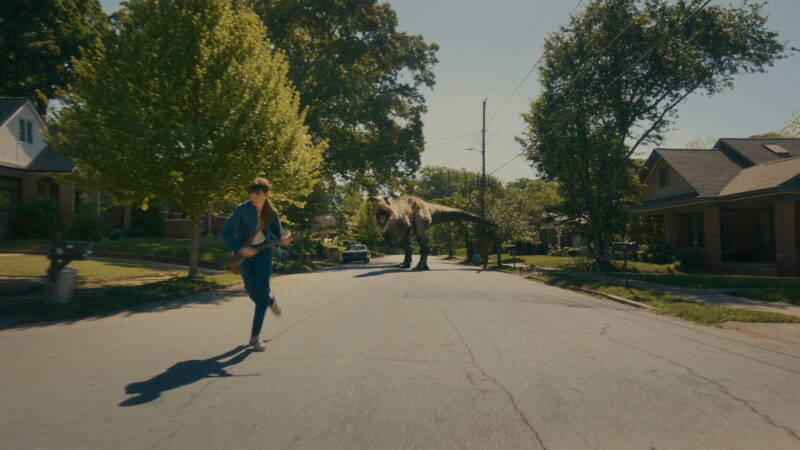
In "The End of Oak Street," David Robert Mitchell orchestrates a magnificent, blood-soaked temporal collision. By violently tearing a slice of mundane suburbia from the space-time continuum and dropping it directly into the Mesozoic food chain, he delivers a wildly audacious high-wire act. It's a picture that balances the popcorn-thriller awe of a classic summer blockbuster with a deeply cynical, underlying cruelty, proving that Mr. David Robert Mitchell has not lost his appetite for dread.
The critical consensus has been strangely quick to dismiss the film as a synthetic regurgitation, with detractors complaining it feels like a Spielbergian pastiche spat out by an algorithm. That assessment is as lazy as it's unearned. While Mitchell undeniably leans into familiar Amblin tropes, he does not merely trace the outlines of his predecessors; he pens a vibrant, thrilling love letter to the wonder of those cinematic milestones. For anyone whose appetite has long craved the specific, unhinged mayhem of a suburban neighborhood overrun by ancient apex predators, this is a long-overdue triumph. Where The Lost World: Jurassic Park teased the concept with a fleeting San Diego detour, and 65 utterly squandered its prehistoric potential, Mitchell commits to the bit, providing a thrillingly full throttle family flick, that stands out in a rather middling pool of PG13 dinosaur fare–still dominated by Spielberg's 90s smash hit.
Despite operating under a studio-mandated PG-13 badge, the film carries a surprisingly vicious edge. The violence never feels disingenuously sanitized or compromised. When the neighborhood inevitably becomes a prehistoric buffet, the kills land with a satisfying weight that frequently borders on an R-rating. Mitchell captures this temporal home invasion with his signature visual flair, heavily employing split diopter shots to frame the action. Initially, this optical technique is a masterstroke, keeping the intimate, fractured domestic drama in razor-sharp focus while massive theropods blur menacingly in the background. It effectively marries the film's two disparate genres within a single frame. However, Mitchell falls so deeply in love with the gimmick that its persistent, heavy-handed use borders on exhausting by the final reel.
Yet, the true brilliance of the picture lies not in its cinematic flair, but in the chilling implications of its climax. Pedants have wrung their hands over the film’s time-travel paradoxes and seemingly triumphant resolution. In a medium built on illusion, debating the logistical purity of time travel is a fool’s errand; what matters is the psychological wreckage the mechanics leave behind. When Denise makes a desperate phone call to pull Greg out of the neighborhood just before the temporal displacement, she secures her own idyllic survival. But the moral cost of this fractured timeline is staggering.
By deliberately altering the event, Denise effectively abandons an alternate version of herself and her children to the prehistoric meat grinder, stripping them of Greg’s protection. To call this a conventional "happy ending" is to ignore a devastating act of selfishness that could have critical consequences. It's a stealth cosmic horror story masquerading as a warm family reunion, and anyway, it's highly probable that the finale was the (reworked) result of studio meddling—a compromise to placate executives terrified of Mitchell's historically grim sensibilities. But Mitchell is too smart a filmmaker to simply roll over. He weaponizes the studio’s demand for a neat, bloodless resolution, smuggling a profoundly depraved conclusion right past the censors. "The End of Oak Street" is not just an exhilarating monster movie; it's a portrait of suburban survival at its absolute most ruthless... as ruthless as a PG13 allows.
8.5/10
Add comment
Comments