REFN... I f*cking love you. And I get you dude, or at least, I think I do.
It takes a special kind of cinematic cowardice to sit before a towering, blood-soaked pastel nightmare and quickly dismiss it as "style over substance," simply because it didn't work for them. When Nicolas Winding Refn's "Her Private Hell" released to the public to a polarized mixture of ecstatic standing ovations and furious walkouts, the chorus of complaints from an increasingly impatient, spoon-fed generation of filmgoers was depressingly predictable. They called it an "absolute mess." They whined about its sluggish pacing and its lack of any narrative. As a die-hard NWR fan—someone who initially wrestled with the abrasive beauty of Only God Forgives and The Neon Demon before later recognizing them as masterworks—I am ashamed to admit that the collective whining of these cinematic tourists made me delay my foray into his new world. I momentarily let the pearl-clutching of a literal-minded generation of snowflakes sever my trust in my own gut. More for me. So... I'm here to put that right, and all of you... Irredeemables. Haha.
"Her Private Hell" is a masterpiece of psychological surrealism, a film that doesn't just invite you into the darkest depths of its protagonist's fractured psyche; it violently drags you there and locks the door.
To view this film through the lens of literal, waking logic is to aggressively miss the point, akin to complaining that a Dalí painting has poor structural engineering. Refn drops us into a futuristic, neon-drenched metropolis entirely suffocated by a mysterious mist. But this isn't a sci-fi weather event or a toxic weapon; the mist is trauma. It's the isolating, impenetrable fog of a shattered mind trying to survive a reality to painful to inhabit. Our avatar in this avant-garde fever dream is Elle, a troubled actress holing up in the Tower Hotel. The "Hell" of the title isn't a subterranean realm of fire and brimstone; it's Elle's own looping, inescapable memory of abuse at the hands of her lecherous, narcissistic filmmaker father, Johnny Thunders.
Refn operates on pure dream logic here, pulling heavily from the neon-soaked traditions of Dario Argento and the Italian giallo, perfectly amplified by a soaring, operatic score from legendary composer Pino Donaggio. When the film's terrifying boogeyman, the Leatherman—a supernatural entity with diamond-encrusted gloves who rips the chests of his victims wide open—stalks the mist, he's not a literal serial killer. He's the physical manifestation of her predatory father’s toxicity. (It's a brilliantly grotesque touch that his victims scream "Daddy!" just before their slaughter). To combat this monster, Elle's fractured subconscious builds a protector: Private K. Triggered simply by finding a lighter bearing that name, Elle's psyche hallucinates a devoted, superhero-level soldier who will traverse a crystalline ghost realm to save his daughter. He's the exact inverse of her real, neglectful father. The film is fundamentally a staged internal war inside a young woman’s head, pitting her desperate need to be protected against her absolute terror of being destroyed.
Because the film's grammar is entirely psychological, traditional character consistency is deliberately thrown out the window in favor of primal expression. Look no further than the third act, which has caused many a pedestrian critic to throw their hands up in frustration. Elle's abrupt pivot into aggressive, unhinged behavior—culminating in a deeply provocative, jarring scene where she forces her own underwear into the mouth of her friend-turned-stepmother, Dominique—is not sloppy writing. It's a calculated subversion. Refn pushes Thatcher into the hyper-theatrical camp conventions of gothic melodrama, shattering her signature quiet containment to depict a raw, subconscious breakthrough. The scene intentionally feels disingenuous to the reality of the character up to that point because it is not reality. It's the ambient, violent dominance of her internal agony finally erupting to the surface, a desperate manifestation of her repressed abandonment issues and the crushing weight of fame.
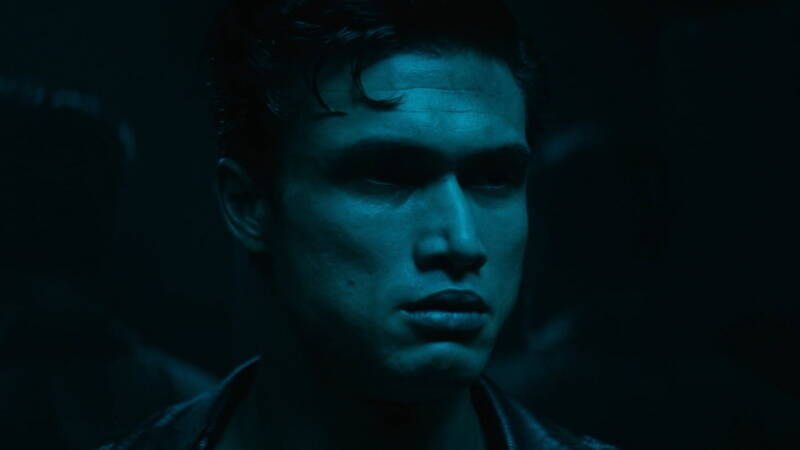
Let’s talk about Charles Melton, who is actively incinerating any lingering memory of his Riverdale origins and forging himself into a lethal indie chimera—a mesmerizing crossbreed of Ryan Gosling’s glacial stoicism and Robert Pattinson’s unhinged art-house sensibilities. As Private K, Melton is utterly magnetic, channeling the repressed, simmering violence of Julian from Only God Forgives. He is tasked with being a literal silent superhero charged with extracting Elle from her nightmare; he never utters a single line of spoken dialogue, communicating entirely through a haunting internal monologue and a devastating physical presence. Opposite his silent masculinity, the female ensemble conjures a terrifying, glamorous alchemy that populates this pastel purgatory. Sophie Thatcher, Havana Rose Liu, and Kristine Froseth operate on a synchronized frequency of high-camp surrealism, weaponizing the aesthetics of the Hollywood starlet. Froseth is particularly striking, perverting the 'manic pixie dream girl' trope into something deeply unsettling—a deluded, fame-poisoned apparition drowning in the neon glow of fortune. Together, they are the beautiful, terrifying architects of Elle's ambient hell.
Anchoring this pastel purgatory is Sophie Thatcher, delivering a masterclass in weaponized containment. Refn treats her haunted, translucent gaze as the film’s emotional bedrock, framing Elle less as a traditional protagonist and more as a traumatized avatar teetering on psychological collapse. Thatcher initially executes a severe, deliberate stillness that makes her third-act pivot into hyper-theatrical mania so jarringly effective. When she abruptly erupts into aggressive dominance—eschewing grounded realism during that violently provocative confrontation with her stepmother—she channels pure subconscious agony. It is a fearless embrace of gothic melodrama, brilliantly physicalizing a fractured mind buckling beneath the weight of abandonment and predatory exploitation.
Beneath the blood-slicked veneer and the hypnotic trance of its cinematic influences, "Her Private Hell" pulses with an achingly personal undercurrent. For all its avant-garde extremity, this is fundamentally an act of cinematic self-flagellation born from profound paternal anxiety. The film operates as a dark, twisted mirror reflecting Refn’s own deepest fears regarding his relationship with his daughter and the toxic, carnivorous industry he has inevitably tethered her to. By rendering the ultimate antagonist as a vampiric, exploitative filmmaker father, Refn is brutally interrogating his own legacy and his absolute terror of failing as a protector in a world built on vanity. The blinding mist, the supernatural monsters, and the fractured psychological madness are not just Elle's trauma—they are a father’s panicked realization that the glamorous, neon-lit cinematic universe he spent his life constructing might actually be the exact nightmare his child has inherited.
As a horror experience, the film is genuinely terrifying. The kills are brutal, unforgiving, beautifully staged, and perfectly lit—swathed in NWR's trademark pinks and blues. Every shadow and saturated hue feels painstakingly designed to evoke an uncanny sadness alongside the supernatural terror. If anything, the sheer unhinged, body-horror madness on display here has me chomping at the bit for Refn’s long-rumored take on Maniac Cop.
Ultimately, "Her Private Hell" functions less like a standard thriller and more like a therapeutic hallucination bathed in DayGlo. I can understand the misinterpretations. I can understand those who struggle to access its abstract wavelength or surrender to its deliberate pacing. But there is a profound difference between acknowledging a film isn't for you and thoughtlessly trashing a meticulously crafted piece of art just because your brain refuses to comprehend its metaphors. Nicolas Winding Refn thrives on being polarizing. He has spent his entire career building a legacy of uncompromising, unwatered-down visions, and he isn't about to surrender that now just to placate the impatient. He made this film for himself, his daughter, his collaborators, and his true fans. If you can't stomach the nightmare, step out of the mist. We'll enjoy the hell without you.
8.5/10
Add comment
Comments