For the better part of two decades, my cinematic loyalty has been stubbornly uncompromising: Tobey Maguire was the definitive Spider-Man. He was the gold standard of the bruised, operatic hero, and for a long time, Tom Holland felt like the lightweight alternative—an energetic, iron-clad mascot riding the coattails of billionaires. But "Spider-Man: Brand New Day" fundamentally obliterates that safety net. Destin Daniel Cretton has not merely directed a superhero sequel; he has orchestrated a brutal, beautifully realized crucible. It forces a rigid skeptic to finally concede the unthinkable: Holland has not only grown into the costume, but he has also delivered what is unquestionably the most emotionally mature, grounded, and definitive portrayal of Peter Parker ever put to film.
This is not the hotheaded, wide-eyed kid who tumbled onto an airport tarmac a decade ago. Cretton introduces us to a young man who is beaten down, fractured, and swimming in a purgatory of his own making. Having lost absolutely everything, Peter’s current existence is defined by isolation. The sequences where he quietly stalks the perimeter of Ned and MJ’s lives are beautifully heartbreaking, portraying a ghost haunting his own past. By stripping away his support system, the film allows Holland to explore the immense, suffocating weight of the Spider-Man legacy. Historically, superhero cinema has a terrible habit of undercutting genuine trauma with an overarching, unserious lightness—a sarcastic quip deployed to save the audience from feeling too much. Brand New Day, however, masterfully threads the needle. It finds a perfect, elusive equilibrium between raw, devastating maturity and Spidey’s trademark bravado. The humor is still there, but it now functions as a desperate coping mechanism rather than a punchline, making the film both digestible and profoundly important as a narrative about growing up.
At the core of its bleeding heart, this is a film that speaks on the brutal necessity of evolution. It holds a mirror to our own deeply flawed reality, echoing the harsh truth that if you do not adapt to the times, you will be utterly dominated and erased. The world Cretton paints takes no prisoners. Peter is backed into a corner by physical and mental changes, forced to confront a new, menacing threat that endangers the only tether he has left in MJ. The narrative insists that to survive the relentless, everyday villains that life throws at us, we have to endure the pain of shedding our old skins to become who we are meant to be.
This thematic grit is matched entirely by the film's visual language. Cretton grounds the spectacle by placing the audience directly inside the claustrophobic, adrenaline-soaked perspective of the mask. The up-close POV shots and the meticulously crafted web-slinging choreography are easily some of the most kinetic and visceral of the entire franchise, right up there with some of the best achieved in the Maguire or Garfield eras. You feel the terrifying velocity, the sudden drops, and the sheer physical toll of navigating a concrete canyon.
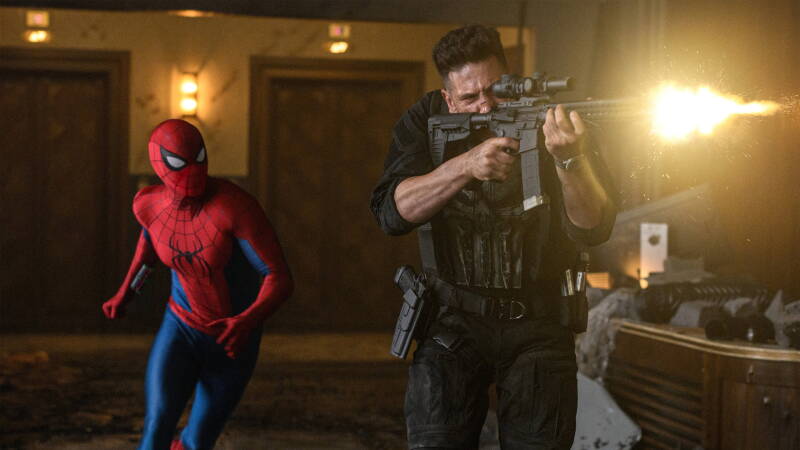
Yet, Peter is not navigating it entirely alone, which brings us to the fascinating, deeply flawed inclusion of Jon Bernthal’s Frank Castle. I approached the Punisher’s integration with a healthy dose of cynicism, fully expecting the character’s R-rated, borderline psychopathic edges to be sanded down into unrecognizability. Surprisingly, the emotional resonance of their dynamic overrides the censorship. Frank steps in as a dark, compassionate, albeit deeply misguided guardian. He genuinely cares for the kid, but Frank is still Frank; his scorched-earth philosophy bleeds into Peter's already fractured psyche. The emotional beats, the shared chemistry, and Peter’s internal battle against Frank's lethal persistence are in part, some of the narrative highlights of the film. Where the movie fumbles, however, is during the kinetic action sequences. The profound, mentor-student tension occasionally devolves into petty, sitcom-esque squabbling mid-firefight. It’s a cheap, lazy concession to the multiplex crowd—a blatant ticking of the "child-friendly" box that briefly cheapens an otherwise stellar dynamic.
A similar corporate mandate is felt in the presence of Mark Ruffalo’s Bruce Banner. In an era where Marvel treats its legacy characters like algorithmic cannon fodder to artificially inflate box office receipts, Banner’s inclusion initially felt like a threat to the film’s intimate scale. Fortunately, he passes the test. Ruffalo delivers some much-needed screen time with Spidey, and anchors a few phenomenal set pieces. But let’s not kid ourselves: the movie would have functioned flawlessly without him. He is a marketing tool, albeit one that is integrated with enough respect that it doesn't entirely derail the picture.
Where the film genuinely deserves a harsh reprimand is in its clumsy, deeply cynical political subtext. Throughout the runtime, the narrative heavily flirts with the normalization of a surveillance state—a theme that feels painfully backward for a grassroots, neighborhood hero. Knowing Marvel’s historical, symbiotic ties with military and government apparatuses, it is hard not to view this as a heavily pushed agenda, peaking in a painfully blatant White House Instagram endorsement of surveillance architecture. It is a massive misstep to feed this normalization to a younger audience. The film attempts to camouflage this systemic endorsement by using Tramell Tillman’s William Metzger, the head of Damage Control, as a convenient MacGuffin. Tillman is electric in the role, but the character is a calculated red herring. By painting the boss as the "real villain," the studio cheapens the critique, suggesting that an invasive panopticon is perfectly fine as long as a "good guy" is sitting at the monitors.
And speaking of corporate flexing, one cannot help but roll their eyes at the shameless product placement for Bero—Holland’s own non-alcoholic beer brand—tucked neatly into the opening fifteen minutes. It’s a jarring, fourth-wall-shattering distraction, but in an industry built on cross-promotion, you almost have to respect the sheer audacity of a leading man utilizing a blockbuster tentpole to boost his side hustle.
Ultimately, despite its studio-mandated rough edges and ideological missteps, "Spider-Man: Brand New Day" is a triumph of character study over empty spectacle. It takes a broken kid, drags him through the absolute ringer, and forces him to earn the mantle in a world that refuses to play fair. It’s not just a great superhero movie; it is a vital, uncompromising story about survival.
8.5/10
Add comment
Comments