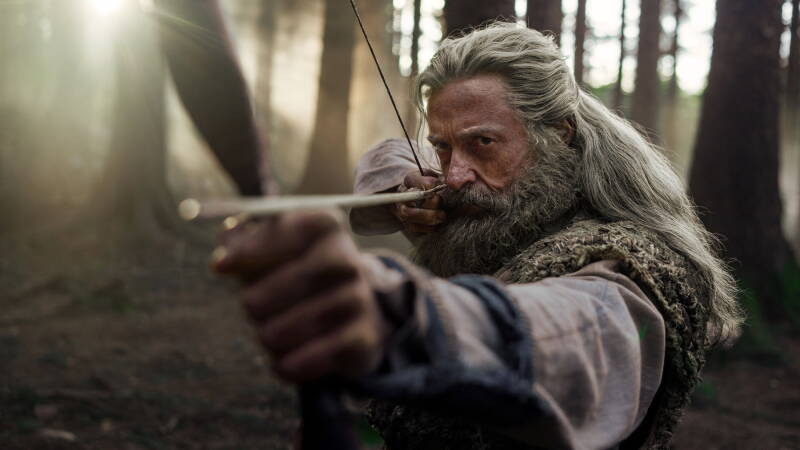
We have spent centuries dressing Robin Hood in Lincoln green and righteous virtue. He's the rogue who robs the rich to feed the needy—a champion of the common folk laughing in the face of tyranny. But what we often forget is that legends are porous, fragile things, easily twisted into perverse nightmares depending on who survives to tell the tale next. In Michael Sarnoski’s "The Death of Robin Hood," the velvet of myth is violently stripped away, leaving only the blood-soaked mud of 13th-century England and a man drowning in the consequences of his own personally curated mythology. If you have seen the marketing for this A24 release, you might expect two unbroken hours of kinetic, limb-severing chaos. Sarnoski, however, possesses a much more sophisticated compass. He understands that light and dark must hold each other in a perilous equilibrium. What he has crafted is a film of two distinct, staggering halves: a descent into a ferocious hell, followed by an agonizing, slow-burn crawl toward a semblance of grace.
Sarnoski, who previously navigated the topography of grief in Pig, does not spare the rod in his opening hour. It's an unforgiving, bleak, and unrelenting assault on our preconceived notions of heroism. This iteration of Robin Hood does not selectively target corrupt sheriffs or pompous lords; he's a monster of indiscriminate slaughter. Men, women, children, and livestock fall prey to a bloodlust so feral it turns the stomach. It's a grueling watch, one that dares you to entirely abandon the protagonist. Yet, this cinematic crucible serves a vital, horrifying purpose: it establishes the sheer, unvarnished weight of the sins for which this man must eventually answer, if he is to leave the world a little better than the one he ravaged in life.
Then comes the pivot. The second hour shifts from a visceral nightmare into a nuanced cautionary tale about how violence intrinsically begets violence. As Robin’s physical momentum halts, the internal wreckage comes sharply into focus. He begins to recognize the wickedness of his ways and the collateral damage of his bow. Here, the film transcends mere revisionist history. It does not hand its protagonist a cheap, unearned redemption. For a man with a past this monstrous, absolution is not a destination you can simply walk toward; it's a sheer cliff you must scale with bleeding fingers, only to hurl yourself off the top and begin again. Sarnoski's narrative refuses easy answers or comforting finality. It acknowledges how bleak even the brightest hope can be, demanding that Robin face his recompense in the eyes of those he has wronged, knowing full well he does not deserve their forgiveness but they deserve to be free of the terror and hurt his cycle of violence inflicted upon them.
To navigate this suffocating transition, a film requires an anchor of immense gravitational pull. Hugh Jackman provides exactly that. Delivering a monumentally courageous performance—accent immaculate, movie-star vanity entirely discarded—Jackman moved me, enraged me, broke me, and miraculously rebuilt me. He allows us to witness the agonizing realization of a man staring into the abyss of his own legacy. It's a visually magnificent picture, captured with overcast, bruised textures by cinematographer Pat Scola, and scored to weeping perfection by Jim Ghedi. The music and images work in tandem to mirror Robin’s internal geography: vast, desolate, but capable of catching a rare, piercing ray of sunlight.
"The Death of Robin Hood" forces a confrontation with our own societal myth-making. When we're gone, our stories can be warped into something entirely alien; a life's work can curdle into a campfire horror story. Our only true legacy is the impact we leave on the flesh-and-blood people who survive us. By watching the most vile of men muster the foresight to confront the evil he has wrought—implementing a way to fix what he has broken with zero expectation of pardon—we are offered a battered, bruised sort of optimism. The world can become a better place. But we must first be willing to march through the deep bog lands of the misery and sorrow we created, bearing the weight of our failures, before we can ever expect to see the sun shine again.
8/10
Add comment
Comments