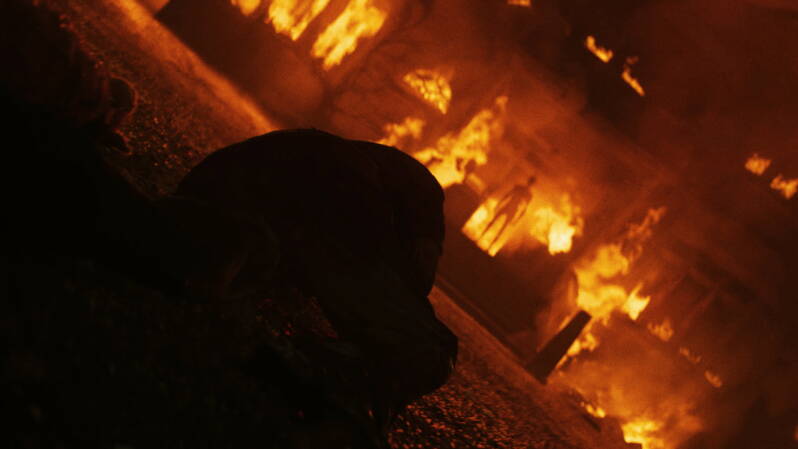
The Evil Dead franchise has long operated on a bloody fulcrum between slapstick lunacy and grueling endurance test. With "Evil Dead Burn," French director Sébastien Vaniček kicks that fulcrum out from under the audience entirely. This is the meanest, nastiest, and ickiest chapter of the saga to date—a film that spills guts with glory and leaves you feeling like you’ve just survived a prolonged, intimate assault. Vaniček doesn't merely want to scare you; he wants to grind your nerves into a fine paste, delivering a wickedly satisfying burn that redefines the modern boundaries of the franchise.
Beneath the geysers of blood, the horrors of Burn are inextricably entwined with the bleakest thematic undercurrents the series has ever tackled. The possession narrative is anchored to the suffocating weight of domestic abuse.The cycle of violence is quite literally ignited by a Deadite-caused car accident that claims the life of Will, the abusive husband of our protagonist, Alice.Gathering with her estranged, toxic in-laws at a secluded house, Alice's existing trauma becomes the psychological bedrock upon which the demonic carnage is built. The Deadites here are not merely chaotic tricksters; they are the physical manifestation of generational rot, weaponizing family secrets and unearthing the darkest domestic resentments.
If the film stumbles, it does so in its first half, where the narrative machinery relies on characters making aggressively dumb decisions for the sake of cinematic effect. We watch, frustrated, as individuals wander into the dark or make choices that actively invite disaster. Vaniček has a habit of letting the camera linger on these poor fools for a beat too long—a pregnant pause that telegraphs their idiocy right before the carnage erupts as a direct result of their mistake. It's a contrivance that briefly cheapens the dread. Luckily, salvation arrives in the final third when Alice finally takes the reins. Shedding the victimhood imposed upon her, she begins to kick ass and make sharply pragmatic choices, culminating in a ferocious display of metal-bladed strimmer carnage that firmly establishes her in the pantheon of great horror survivors.
Everything an Evil Dead fan could want and need is present and correct, making it a blood-soaked new member of the family. DP Philip Lozano’s restless camerawork captures the madness with a kinetic claustrophobia, seamlessly aided by exquisite post-production transitions that spotlight the talents of a magnificent editorial craftsman. The franchise's trademark toolshed of domestic weapons and shrill ordeals bordering on the comic are deployed with lethal precision, but the violence itself has been drastically escalated.
Vaniček seemingly took the infamous cheese grater sequence from Lee Cronin's Evil Dead Rise as a personal challenge, outdoing it with a seemingly benign women's razor repurposed into an agonizing facial peeler. It's an excruciatingly hard watch. And Vaniček, frankly, is evil for it. Yet, the craziest thing about the film's brutality is its occasional, forced restraint. In a movie that goes full-tilt ferocious in nearly every frame, there are moments where the camera deliberately pans away or relies entirely on off-screen audio. The fact that the film feels this unrepentantly gory, yet leaves you with the distinct impression that they had to dull down some sequences to avoid an outright ban, blows the mind.
The sound design is its own masterclass in auditory torture. When a fountain pen is driven into an ear canal, the audio perfectly mirrors the victim's ruptured senses—emitting a high-pitched screech that burrows into your skull as the camera shakes violently in sympathy. Elsewhere, a prolonged, agonizing sequence in which a patriarch subjects himself to a three-stage act of ballistic self-mutilation right in front of his family pushes the boundaries of what an audience can theoretically stomach.
Vaniček’s staging reaches its absolute zenith in two staggering, unbroken takes that induce pure, visceral anxiety. The first traps us inside the agonizingly tight confines of a vehicle, unleashing a near five-minute blitzkrieg of close-quarters combat. Every conceivable object in the car—down to small surgical scissors and detachable headrests—is utilized in a claustrophobic bloodbath, with the camera refusing to blink or pull back from the lunging terror. The second is an absolutely relentless marvel of architectural destruction within the dilapidated house. The camera stays low, anchored to Alice as she desperately crawls out of sight, hoping to remain undetected while a jaw-dropping melee rages around her. Bodies are tossed through walls, ceilings, and mirrors, constantly entering the frame from dodgy, unpredictable angles. The sheer physical toll of the sequence, driven entirely by the bone-crunching sound of the surrounding chaos, is a stroke of kinetic genius.
Yet, beneath the bleakness, the pitch-black humor remains intact. It's the darkest comedy the series has ever dared to deploy, devoid of any slapstick safety nets. Much of this is courtesy of Maude Davey’s unhinged, foul-mouthed turn as Grandma Polly, who spits venom with gleeful abandon. The psychological warfare is just as sharp as the physical, perfectly encapsulated when a fully possessed Deadite Thya absolutely destroys the crumbling masculinity of Joseph, with nothing but her words.
"Evil Dead Burn" is an exhausting, wicked triumph. It wades through the muck of human failing and demonic cruelty, emerging as a ferocious beast that respects its roots while carving out a deeply traumatizing identity of its own, leaving you bruised, battered, and begging for more.
8/10
Add comment
Comments