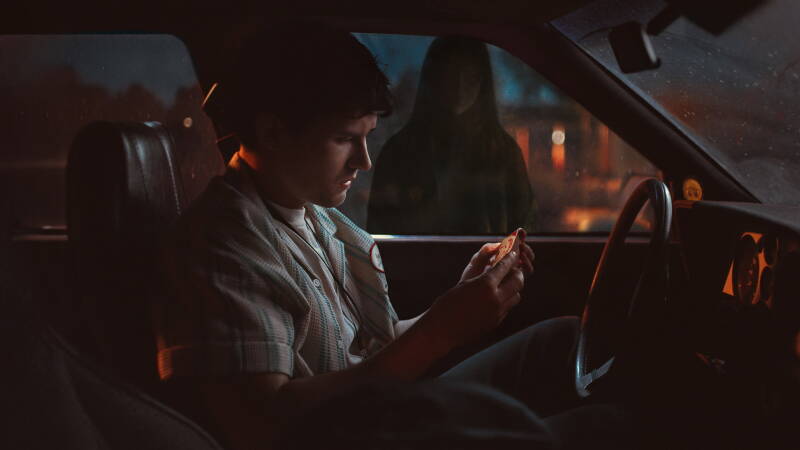
Cinematic terror is too often outsourced to the extraordinary—the masked boogeyman, the supernatural entity, the chainsaw-wielding brute. But Curry Barker’s "Obsession" understands a far more nauseating truth: the most profound evil usually wears a cardigan, averts its gaze, and genuinely believes it's the victim. In dissecting the rotting anatomy of modern male entitlement, Barker has constructed a psychological crucible that completely decimates the romantic comedy’s foundational myth. We have been conditioned by decades of cinema to root for the unassuming, lovelorn wallflower. Here, we're forced to watch him weaponize his own pitiable inadequacy to obliterate the autonomy of the woman he claims to adore.
Bear, played with a skin-crawling banality by Michael Johnston, is the ultimate manifestation of the friend-zoned archetype—a man whose crippling insecurity is matched only by his suffocating narcissism. When his desperate infatuation with his lifelong friend, Nikki, meets the magic of the "One Wish Willow," Bear doesn't just cross a moral boundary; he annihilates the very concept of consent. The true genius of Barker’s screenplay lies in its refusal to grant Bear the theatricality of a mastermind. He's a coward. His malice is entirely passive. Even when confronted with the grotesque reality that his wish has hollowed out Nikki’s soul, replacing her vibrant independence with a terrifying, algorithmic devotion, Bear simply accepts the transaction and questions what's so bad about him? Why she couldn't love him. He chooses the comfort of a synthetic, blood-stained affection over the basic humanity of the woman standing in front of him. It's a damning indictment of a specific male fragility that would rather subjugate a partner than face the terrifying vulnerability of rejection.
Crucially, Barker refuses to let Bear hide behind the convenient cinematic excuse of a cursed object. The "One Wish Willow" is no malevolent Monkey’s Paw inherently designed to punish hubris with ironic tragedy; as evidenced by Ian, who effortlessly secures a billion dollars without cosmic retribution (what happens to him is a devastating branching effect of Bear's wish, not his own), proving the artifact is a neutral, indifferent conduit of possibility. The profound, suffocating evil of Obsession originates entirely within the architecture of Bear’s own desires. By wishing for Nikki’s affection, he's not casting a misguided romance spell—he's demanding the psychic assassination of her free will. To force such a bond is to actively mandate the execution of a woman’s autonomy and her fundamental right to consent. The magic did not twist his intentions; it simply obeyed a totalitarian urge Bear already harbored, proving with chilling clarity that the rot was never in the wood of the willow, but in the marrow of the man who held it.
The horror that befalls Nikki, portrayed in an astonishing, dual-layered performance by Inde Navarrette, is where the film transcends standard genre fare and becomes something uniquely agonizing. What the wish forces upon her is not a simple demonic possession, but a profound erasure of self. She is reduced to a grotesque parody of the patriarchal ideal—hyper-fixated, relentlessly needy, and entirely stripped of her own desires. Barker captures this violation with a suffocating dread. The most terrifying moments are not the inevitable outbursts of violence, or the physically insane ways in which her body moves (beautiful nod to Kurosawa's "Pulse" may I add), or the haunting sounds that come out her mouth, but the agonizing fractions of a second where the real Nikki breaks through the facade. Her whispered pleas and moments of lucidity, trapped within a physical vessel that is actively being piloted by another man's insecurities, evoke a primal, stomach-churning panic. It's a literal manifestation of emotional domestic abuse, where a woman’s entire identity is cannibalized to keep a weak man’s ego inflated.
Barker orchestrates this descent with an unflinching, almost clinical detachment. The film is devoid of the triumphant survival tropes that usually offer the audience a reprieve. Instead, it wallows in the bleak, claustrophobic reality of a one-sided delusion made flesh. Bear’s refusal to intervene, to shatter the illusion and set her free even as the collateral damage mounts, exposes the darkest underbelly of obsessive love: it was never about Nikki. It was only ever about Bear. She's merely a mirror he has forced to reflect a version of himself he desperately needs to see, and he is perfectly willing to let her bleed out if it means the reflection stays intact.
To watch "Obsession" is to endure a masterful, relentless psychological suffocation. It is a film that refuses to let you look away from the ugly, unvarnished reality of coercive control. Barker has crafted a cinematic nightmare that burrows under the fingernails and refuses to wash out, not because it employs cheap scares or excessive gore, but because it holds up a mirror to the quiet, everyday predators who walk among us. They do not hunt in the woods. They stand in the corner at parties, quietly resenting the world for not giving them what they feel they are owed, waiting for the moment they can force the universe to bend to their agonizingly small wills. This is an uncompromising triumph of the genre, a film so intensely observed and flawlessly executed that it will leave you shivering long after the final frame cuts to black.
10/10
Add comment
Comments