There’s a specific kind of disappointment that only comes from a sequel that should work—one that has all the raw ingredients to go bigger, sharper, and more impactful, yet somehow dilutes what made the original so effective. "Ready or Not 2: Here I Come" lands squarely in that space: louder, bloodier, and undeniably more ambitious, but curiously hollow where it matters most.
On paper, the escalation makes sense. The film amplifies everything audiences responded to in Ready or Not—the violence is more excessive, the set pieces more elaborate, and the family’s madness pushed further into grotesque territory. But spectacle without substance has a short shelf life. What once felt tightly wound and wickedly intimate now sprawls into something far less controlled, as if the film mistakes expansion for evolution.
The core issue isn’t that it’s bigger—it’s that the added scale isn’t matched by emotional or narrative weight. The original thrived on a sense of claustrophobic tension and a darkly playful intelligence; here, that precision gives way to something more erratic. Character motivations feel thinner, the internal logic begins to fray, and the story leans heavily on momentum rather than meaning. You can feel the film trying to distract you—piling on chaos, bloodshed, and shock value in the hope that you won’t stop to question what’s underneath.
Even the humour, once a defining strength, struggles to land. Where the first film balanced brutality with sharp, self-aware wit, this sequel often veers into something flatter and more forced. The tonal balance is off, leaving moments that should feel biting or absurd instead coming across as oddly muted. It’s not that the film lacks personality—it’s that its personality feels less coherent, pulled in too many directions at once.
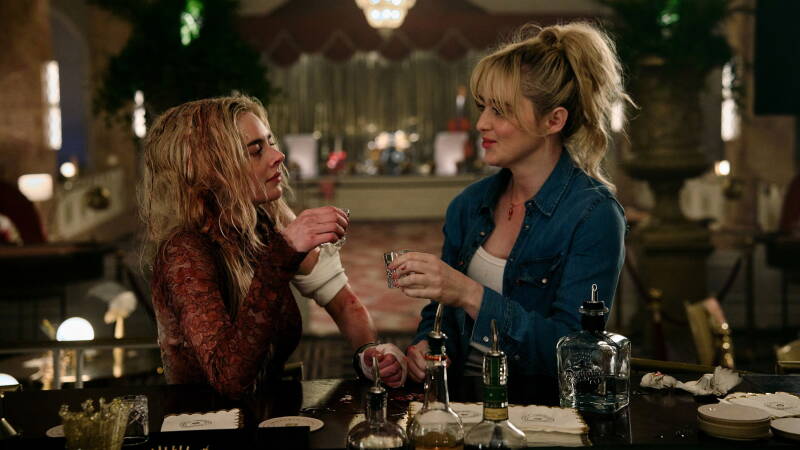
The performances, too, reflect that inconsistency. There’s clear effort, and flashes of chemistry that hint at something stronger, but it never quite locks in. Why was Kathryn Newton cast? Because she's blonde or because she featured in the directors prior outing "Abigail." Because I didn't once believe these two were sisters, and for the most part, the odd pairing didn't work well together. However, seeing Elijah Wood return to the horror space—especially alongside Shawn Hatosy, a reunion that inevitably recalls The Faculty—adds a layer of nostalgia and fun, yet even that isn't enough to subvert attention from the core issues of the film.
That’s ultimately what’s missing: tangibility. The original had a tactile quality—a sense that beneath the absurdity and violence, there was something human and immediate. Here, everything feels heightened to the point of detachment. The film becomes a showcase rather than an experience, prioritising what it can do over what it makes you feel.
That’s not to say it’s without merit. For horror fans who appreciate inventive kills and unapologetic gore, there’s a certain surface-level enjoyment to be found. It delivers on excess, and for some, that will be enough. But beyond that visceral appeal, it struggles to justify its own existence.
In the end, it feels less like a natural continuation and more like a product shaped by the idea of escalation for its own sake—bigger in every measurable way, yet significantly smaller where it counts. And when you step back, it only reinforces how well-contained and effective the first film was. If you’re choosing between the two, there’s little question which one lingers, and which one you will likely revisit.
6/10
Add comment
Comments