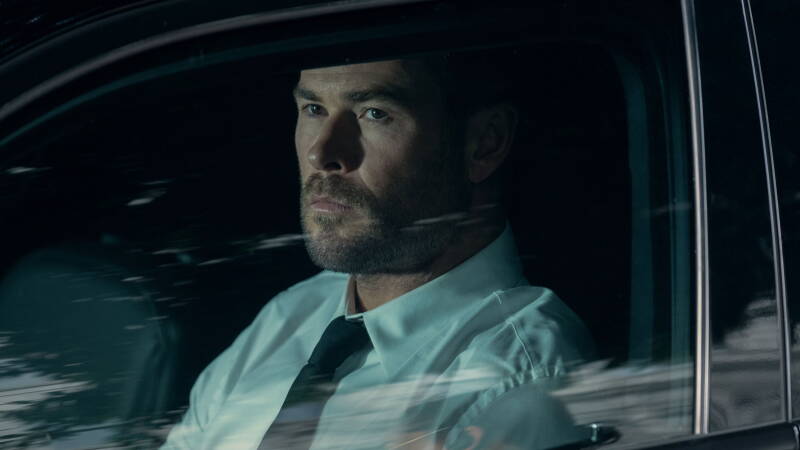
There is an undeniable, intoxicating allure to the nocturnal rhythm of a sprawling city. The midnight hum of tires on asphalt, the glow of dashboard lights against a brooding driver's face, the meticulous orchestration of a high-stakes heist set to a banging, synth-heavy score. I am usually the first in line to lap this up. Give me a slick, neo-noir atmosphere, and I am entirely yours. But as the credits rolled on Bart Layton’s "Crime 101," I was left grappling with a frustrating realization: I am growing tired of arriving at the exact same destination.
Make no mistake, Chris Hemsworth is brilliant in this. Stepping into the tailored, disciplined shoes of elusive Los Angeles jewel thief Mike Davis, Hemsworth sheds his blockbuster bravado for something coiled, and deeply restrained. He navigates the sprawling roads with a quiet intensity that holds your gaze hostage. Alongside him, heavyweights like Mark Ruffalo—playing the quintessential, Columbo-esque Detective Lou Lubesnick whose marriage is inevitably falling apart—and Halle Berry, delivering a razor-sharp turn as an overlooked insurance broker caught in the crossfire, bring immense gravity to the screen. Even Barry Keoghan shows up as the obligatory, unhinged wild-card rival to throw a wrench into the gears. The talent is undeniable, but a phenomenal cast can only do so much to distract from a fundamentally derivative blueprint.
The core issue with "Crime 101" is its suffocating devotion to its predecessors. It's a relentlessly formulaic crime thriller that follows the exact same playbook of every successful film of its ilk. Layton, who previously demonstrated an incredibly fresh, boundary-pushing vision with "American Animals" and "The Imposter," plays it agonizingly safe here. The film coasts entirely on the coattails of Michael Mann’s "Heat" and the atmospheric coolness of Nicolas Winding Refn’s "Drive." From the "one last big score" trope and the obsessive, mirroring dynamic between the cop and the robber, to the beautifully shot, neon-soaked Los Angeles skyline, the film weaponizes nostalgia to hide its utter lack of narrative innovation.
It’s easy to see why it has earned a pretty decent reputation. For mainstream audiences, it is edgy and satisfying just enough to pass as a premium, high-budget thrill ride. It hits all the mandatory checkpoints with style and slick cinematography. But if a filmmaker is going to try and bribe me into investing 140 minutes of my time into a cinematic universe, I expect much more. I atleast expect a narrative that challenges the boundaries of the subgenre, rather than just retreating to its safest, most comfortable corners.
We have reached a point of saturation. The aesthetics of the slickly planned crime, the stoic protagonist, and the throbbing synth-wave score are no longer enough to carry a film on their own. I want somebody to take this beloved framework and violently shake it up, to give us a climax, a twist, or a consequence we haven't already seen a hundred times before. "Crime 101" is a gorgeous, well-acted tribute act, but ultimately, it’s just a ghost singing someone else's song.
6/10
Add comment
Comments