Vital - Amir Zargara | Runtime: 14 minutes | Genre: Persian Drama
Logline: A mother in Iran considers selling her organs to save her daughter, while in the United States, a doctor faces ethical dilemmas to save his daughter, revealing the complexities of organ trade.
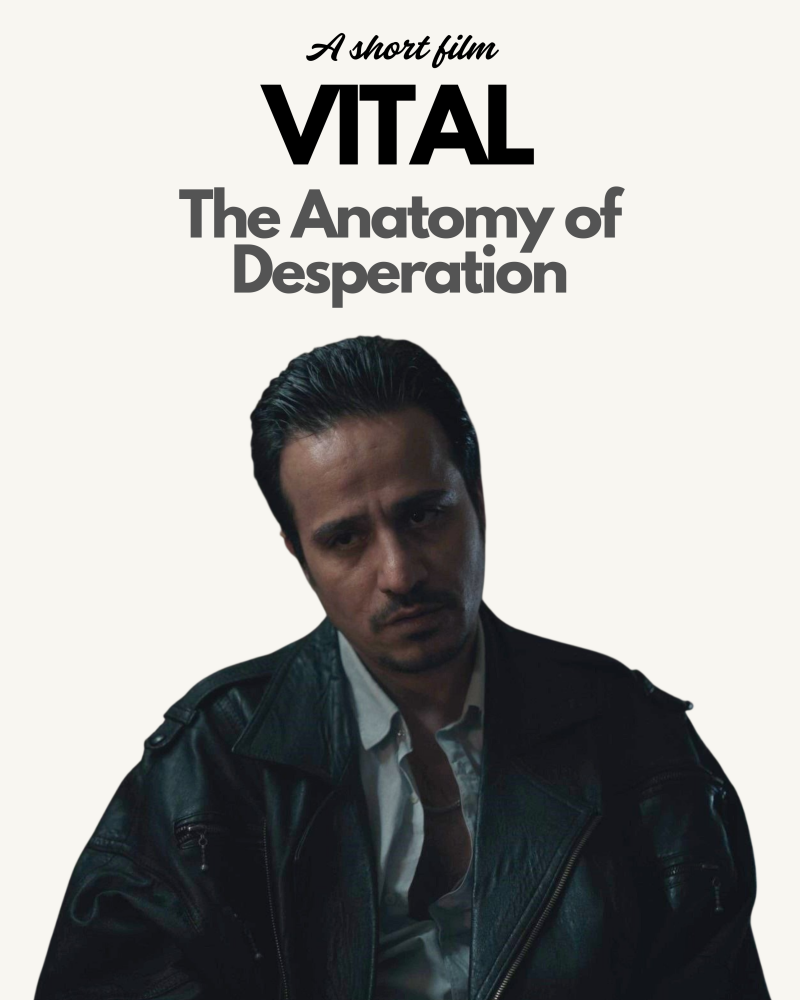
There's a specific, terrifying calculus that occurs when a parent realizes their child is dying, and the only currency left to buy them time is their own flesh. It's easy to philosophize about the sanctity of the human body when you are standing on solid ground. Ethics, as it turns out, are often a luxury funded by circumstance. When those circumstances collapse, the boundaries of the unthinkable begin to shift, and what was once a profound violation of the self becomes a grimly pragmatic transaction. This is the harrowing territory navigated by Amir Zargara’s "Vital," a film that examines the global organ trade not through the cheap thrills of a procedural, but as a devastating mirror reflecting the lengths to which desperation will drive us.
In a suffocatingly tight fourteen minutes, Vital juxtaposes two frantic realities bound by the same shadowy economic supply chain. In Iran, a mother named Fereshteh considers auctioning off her internal organs to fund her daughter's life-saving treatment. Across the globe, an American doctor finds himself paralyzed in his own ethical labyrinth, weighing the cost of crossing lines he swore to uphold in order to procure the means to save his own critically ill child. The brilliance of the script, penned by Zargara and Gabe Berry, lies in its refusal to map this out as a simplistic battle between a noble victim and a predatory Western villain. Both of these individuals are driven by an identical, primal panic. They are divided not by the depths of their love, but by the systemic lotteries that dictate what each is permitted to do with it.
Anchoring this transatlantic dichotomy is a powerhouse performance by Mahtab Servati. Having already proven her formidable dramatic instincts in the Berlinale Golden Bear winner There Is No Evil, Servati operates here with a quiet, devastating gravity. Fereshteh is not a tear-soaked martyr; she is a woman coldly recognizing that her anatomy has become her only remaining liquid asset. She understands that maternal sacrifice itself has been commodified. The supporting ensemble is equally commanding. Reza Akhlaghirad, and Hossein Soleimani, infuse the margins of the story with a heavy, lived-in authenticity. Zargara uses these veteran actors to bypass the need for heavy-handed exposition, allowing their faces to communicate the unspoken indignities of a broken system.
Cinematographer Jelan Maxwell and editor Iman Tahsin beautifully find the claustrophobic symmetry in both worlds. The visual language collapses the distance between North America and the Middle East, locking both families in the same inescapable moral prison. If the film stumbles, it is only against the confines of its own format. The sheer density of the questions Vital asks—about healthcare inequality, the brutal economics of survival, and cross-border exploitation—feels almost too expansive for a fourteen-minute container. At fleeting moments, the immense thematic weight threatens to overtake the intimate human drama, leaving the characters feeling momentarily like avatars for a larger debate. Yet, this very compression also lends the picture its breathless, unrelenting momentum. It leaves no room for pontificating.
Ultimately, the film's title operates on a haunting dual frequency. We are dealing with "vital" organs, certainly, but Zargara is far more interested in what human beings deem vital enough to sacrifice their own humanity to protect. Rather than serving up a comfortably digestible polemic about the evils of the black market, the film forces its audience to confront an uncomfortable reflection. Exploitation, we learn, is rarely the exclusive domain of monsters operating in shadowy alleys; sometimes, it is propelled by the terrifyingly pure machinery of a parent's love. Vital does not care to deliver a sermon or pat you on the back for knowing right from wrong. Instead, it places us directly in the firing line of an impossible choice, leaving us to wonder how fiercely we would cling to our own morals if our child's survival demanded we let them go.
8/10
Add comment
Comments