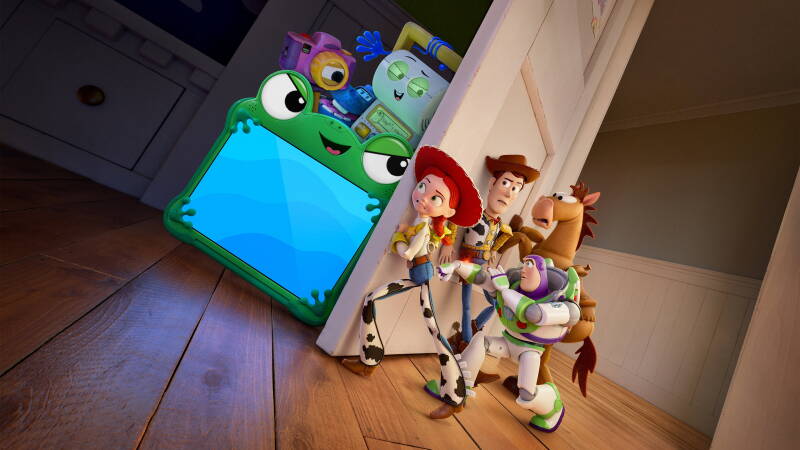
The word “engagement” used to mean looking someone in the eye. Today, it’s a metric. We find ourselves in an era where the greatest existential threat to a plastic cowboy isn’t a rummage sale or a sadistic neighbor, but a piece of glowing glass. "Toy Story 5" arrives perhaps a decade late to the great screen-time debate, but it compensates for its tardiness with a surprisingly sharp indictment not of the children holding the tablets, but of the exhausted adults who handed them over.
Early in the film, a subtle, painfully authentic tableau unfolds: Bonnie’s parents sit at a table, faces absorbed into their smartphones, while their daughter plays alone outside. It's a quiet, everyday tragedy, and a small scene most might miss. The film wisely recognizes that a tablet is often just a digital pacifier, deployed by parents unwilling to navigate the friction of child-rearing. For any thirty-three-year-old parent who still spends afternoons building sprawling LEGO empires, playing dress-up, or exploring the local woodlands alongside an eight-year-old, this visual strikes a profound nerve. The tragedy of the modern parent isn't just the stunting of a child's imagination; it's the impending, crushing realization that they traded finite, unrepeatable memories for the hollow dopamine loops of a social feed.
If the film narrowly avoids collapsing into a preachy, Luddite sermon, it's because it hands the narrative reins entirely to Jessie. Elevating the hyper-kinetic, emotionally volatile cowgirl to the lead is the smartest, most organic decision the studio has made in years. Her character arc is beautifully constructed, bursting with a vibrant roster of new playthings that inject genuine, belly-laugh humor into the proceedings while delivering essential thematic medicine for the younger audience.
Curiously, her ascension exposes a fascinating strain of institutional doubt among her peers. With Woody relegated to a remarkably slight supporting role and Buzz functioning as secondary muscle, there's a lingering, almost archaic skepticism from the male toys regarding Jessie’s ability to salvage the situation solo. It’s an unmistakable critique of the age-old stereotype that a woman requires a man to anchor her crisis—a notion she systematically and delightfully dismantles.
Unfortunately, a film of this scale rarely escapes the gravitational pull of corporate hubris, and here it manifests in a jarring stylistic detour. During the imagination play sequences, the animation pivots into a pastel-hued, 2D pop-art aesthetic. It's an undisguised attempt to capture the lightning in a bottle that Spider-Man: Into the Spider-Verse and Puss in Boots: The Last Wish wielded so brilliantly. But in those films, the hand-drawn elements were baked into the foundational DNA of the storytelling. Here, layered over the pristine, hyper-detailed computer generation that defined the studio's legacy, it feels entirely unearned. It doesn’t complement the CGI; it clashes with it. It serves no narrative or emotional purpose, registering instead as a cynical studio flex—a billion-dollar corporation clearing its throat to say, "Look, we can do that art style too, if we want to."
That same boardroom manufacturing infects the screenplay's scaffolding. The most glaring casualty of franchise bloat is a bafflingly irrelevant subplot involving a platoon of upgraded, high-tech Buzz Lightyear action figures. For the vast majority of the runtime, their inclusion feels utterly pointless, adrift in the main narrative. That is, until the third act, when the script suddenly remembers it has written Jessie and the gang into a corner. Conveniently, it's revealed that these modern Buzz variants are essentially high-powered flying drones. It's a naked deus ex machina, reverse-engineered to provide a clean getaway. The whole conceptual existence of these figures is sacrificed on the altar of a single logistical plot contrivance.
Yet, despite the cynical visual gimmicks and the clunky narrative machinery, the film’s beating heart ultimately saves it from mediocrity. It lands on a nuanced, surprisingly sophisticated compromise: tech and toys can, and must, coexist. The message isn't to burn the servers, but to recognize that technology is a tool of utility, and should never be an excuse to abdicate the joyous responsibility of human connection. "Toy Story 5" operates as an impassioned plea to remember that imagination play isn't a developmental phase to be outgrown, but a shared experience to be cherished. It proves that whether you are eight, thirty-three, or sixty-seven, the magic of sprawling out on the floor and breathing life into a piece of plastic hasn't lost an ounce of its power. We just have to be willing to put down our phones to see it.
7.5/10
Add comment
Comments