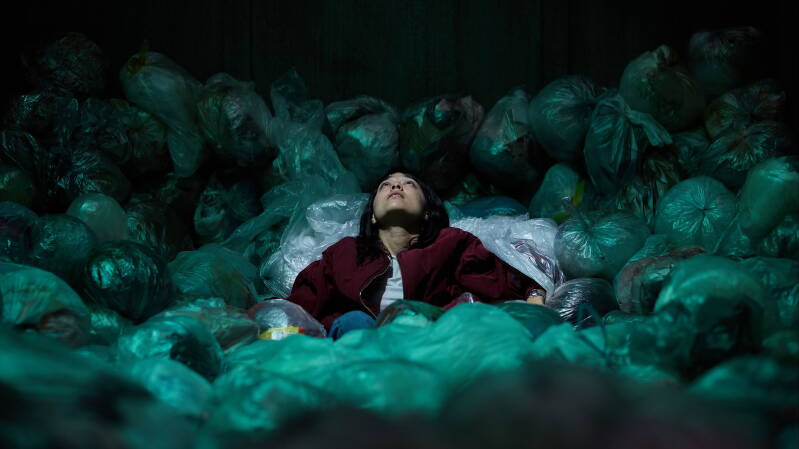
Diet culture is already a horror story; it just usually lacks a physical body count. With "Saccharine," writer-director Natalie Erika James weaponizes the modern obsession with thinness, dragging the quiet, agonizing rituals of body dysmorphia out of the bathroom scale and into the realm of the grotesque. Arriving at a cultural flashpoint where algorithmic beauty standards collide with the unregulated boom of quick-fix injectables like Ozempic, the film doesn't just tap into our collective insecurities—it suffocates them.
At the center of this slow-motion collapse is Hana (a fiercely committed, vulnerable performance by Midori Francis), a medical student caught in the excruciating cycle of dieting, bingeing, and shame. Hana is buckling under the weight of expectations: academic perfectionism, complex queer desires, the heavy, looming specter of her father's reclusive obesity and depressive binge-eating, and the inherited pressure to perform.
When she discovers an underground, highly illicit weight-loss craze known simply as "the Gray," her desperation overrides her medical ethics. The pills allow the user to eat whatever they want while rapidly shedding pounds, but the film’s macabre stroke of genius lies in the pill's active ingredient: human ashes.
What unfolds from this premise is a subtle and deeply effective atmospheric dread. The creeping feeling the film elicits is almost unbearable precisely because it never once relies on cheap, adrenalized jump scares. Instead, Saccharine operates like a psychological cheese grater. Drawing on the Buddhist folklore of the "hungry ghost"—an anguished, insatiable spirit—James constructs a haunting that is largely invisible but physically overwhelming.
The terror is anchored by brilliant sound design. You rarely see the entity stalking Hana head-on; instead, you hear and feel the heavy, gargantuan thuds of an impossibly overweight spirit crushing down on the floorboards. When the ghost does appear, it's only caught in the warped, bulging reflections of convex surfaces like a kettle or a spoon. It's a brilliant visual limitation that forces the audience to actively search for the threat, mirroring the hyper-vigilance of an eating disorder.
James has a deep understanding of how desire and disgust share the exact same real estate in the human brain. Hana’s journey toward conventional thinness is accompanied by a sickening unraveling of her humanity. She treats the dead with a callous utilitarianism, reducing human beings to parts and calories to fuel her own vanity. The body horror on display is gnarly and sticky, refusing to shy away from the sickly reality of physical decay. While it shares a satirical bite with recent feminist body-horror hits like Coralie Fargeat's The Substance, or even the supernatural weight-loss curse of Stephen King's Thinner, Saccharine carves out its own distinct, deeply-disturbed, yet melancholic identity.
Clocking in at nearly two hours, the pacing is undeniably punishing. It moves with the agonizing inertia of a heavily burdened freight train methodically churning toward a row of walls packed with explosives, each getting bigger the closer it gets to the climax. This deliberate crawl has predictably frustrated a certain vocal demographic of moviegoers. We exist in a tiresome cinematic climate where audiences loudly demand original horror, yet instantly complain when they are handed a film that refuses to spoon-feed them simple scares, or tidy moral lessons. They're quick to label something unoriginal just because it has a similiar theme to recent films like The Substance. It's society that creates these stigmas, and correct me if I'm wrong... but has anything really changed about the toxicity regarding beauty standards? I think not. So why not speak about it. None of this makes it unoriginal.
If a slow-burn narrative leaves you impatient, or the subtext flies over your head, there's no shame in simply admitting you didn't get it, or it wasn't for you. Maybe even do a little light reading, search for deep dive reviews, or a film analysis, fill in the blanks, and revisit it. Trust me when I say, you may well be rewarded.
The truth is, contingent on your life experience, some people may pick-up things others do not. And that's okay. That's why talking about films you've seen with others who have different opinions is so interesting. You may pick up something you didn't notice before because somebody made you look for something you didn't think to look for because its not something you are familiar with. For instance, to write off "Saccharine" because its "gruelling repetition" made you uncomfortable is to miss the entire point: the cyclical trap of food addiction and societal shame is uncomfortable, slow, persistent.
"Saccharine" is a bitter, treacly, and thoroughly upsetting piece of cinema. It does not ask to be liked, and it offers no comforting platitudes about body positivity. Instead, it provides a raw, bleeding look at the horrors we inflict upon ourselves in the pursuit of an impossible ideal, and the heavy, crushing ghosts we swallow along the way.
8/10
Add comment
Comments