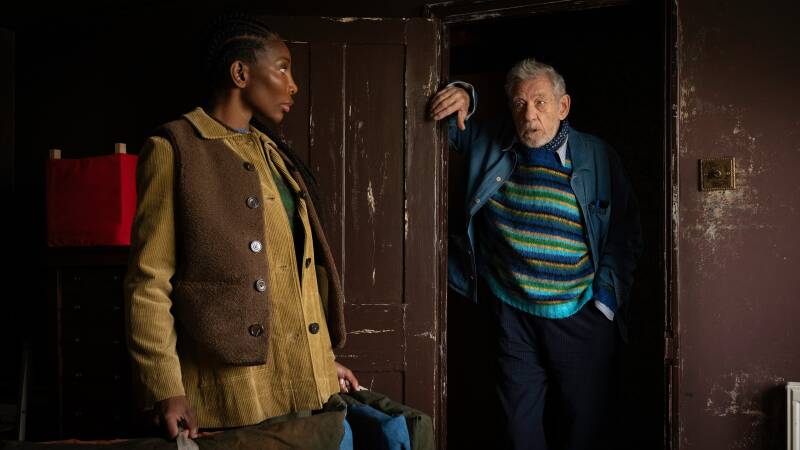
There is a particular kind of tragedy in outliving your own relevance, but there is a fierce, almost terrifying beauty in refusing to go quietly. Steven Soderbergh’s latest film, "The Christophers," takes this existential reckoning and distills it into a blackly comedic, breathtakingly intimate chamber piece. It's a film that operates on the simmering frequency of a psychological thriller, but instead of cracking safes, the characters are cracking open each other's souls. It's a heist where the vault is a man's ego, and the prize... his legacy.
At the center of this storm is Julian Sklar, an elderly, once-lionized titan of the London art scene, played by Ian McKellen in what is undeniably one of the most commanding, intimate, multi-layered performances of his late career. Julian has curdled into a magnificent spectacle of eccentricity and defiance. Sequestered in his cluttered Bloomsbury townhouse, he sustains himself—and his withering vanity—by recording personalized video messages for fans, treating each greeting as a miniature performance of disdain. He's a man who frequently mistakes cruelty for honesty, wearing his monstrous ego as armor against the slow erasure of time, so whomever gets in the line of fire, friend or foe... prepare to take a few licks. Enter Lori, played with quiet, calculating intensity by Michaela Coel. Hired by Julian’s avaricious, estranged children to infiltrate his studio and forge a legendary, unfinished series of paintings, Lori poses as his new assistant. What begins as a straightforward, deceptive plot for inheritance quickly evolves into a scintillating duel of intellect, vulnerability, and manipulation.
Soderbergh has always been a director fascinated by process and deception, but here, he strips away the glossy ensemble mechanics of his broader capers to deliver something far more visceral. Working from Ed Solomon’s razor-sharp script, he locks us inside the claustrophobic, paint-flecked air of Julian’s studio. The tension is palpable. Watching McKellen and Coel parry and thrust is genuinely thrilling; it is an electric collision of two generations, two distinct artistic temperaments, and two deeply fractured creators. Coel grounds the film beautifully, her guarded stoicism serving as the perfect foil to McKellen’s theatrical bluster. She doesn't just hold her own against his tempestuous presence; she slowly dismantles it, exposing the profound sorrow and regret of a master confronting the end of his canvas.
If the film has a limitation, it lies only in the boundaries of its own premise. The narrative machinations of Julian’s children, while entirely necessary to ignite the plot, occasionally pull us away from the magnetic gravity of the central two-hander. Corden and Gunning are effective in their roles, portraying the sour desperation of offspring standing in the shadow of a giant, but you find yourself impatiently waiting for the camera to return to the studio, eager to get back to the philosophical bloodsport happening between the painter and the forger. Additionally, the tight, room-bound nature of the narrative occasionally leans into its inherent theatricality, feeling at times like a magnificent stage play slightly constrained by the medium of film.
Yet, these are ultimately minor quibbles in a work of such fierce intelligence and emotional resonance. "The Christophers" is an intoxicating, introspective meditation on the intrinsic value of art and the heavy toll of making it. Does value reside in the brushstroke, the signature, the financial appraisal, or the blood left on the canvas? The film doesn’t coddle its audience with easy answers or unearned sentimentality. Instead, it delivers a raw, fiercely witty, and remarkably life-affirming portrait of creation and decay, that serves as a brilliant reminder... that even as the light fades, the right artist can still set the entire room ablaze.
8/10
Add comment
Comments