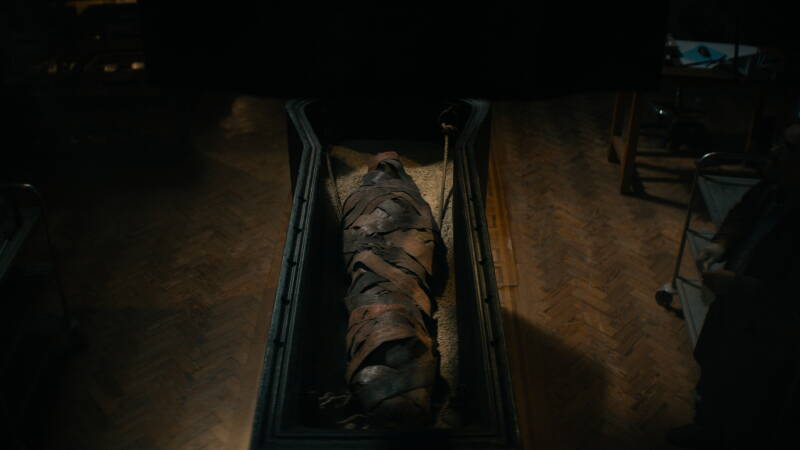
How much raw, flayed anatomy must a person witness before they swear off the local Kebaby for good? It's a dietary conundrum I found myself pondering during the visceral climax of "Lee Cronin’s The Mummy." This is a film so enthusiastically dedicated to the tearing of scabby ass skin that I suspect it could transform the most iron-stomached, post-pub doner kebab aficionado into a militant vegan before the credits roll.
Anywho... To dissect this film is to uncover a failed food hygiene grade at your favourite eatery, so be mindful where you eat. But if you are a brave soldier, and you do decide to look deeper, you'd find a centuries old sterile blueprint beneath the bodily ruin. An architecture so instantly recognizable to anyone who has frequented a commercial theatre to see a "commercial horror."
We're handed the requisite broken family unit, burdened with high emotional stakes to establish immediate sympathy. We are fed the familiar narrative framework of demonic possession. And, right on schedule, we are presented with a corrupted child, rendered as grotesque as state-of-the-art practical effects will allow.
True devotees of the macabre will see through these cynical, box-ticking maneuvers instantly. But this picture was not forged for the seasoned horror hound. It was calibrated perfectly for the casual moviegoer—the kind of water-cooler cinematic event designed to provoke shocked conversations among folks who rarely dip their toes into the genre.
It's the exact brand of heavily marketed shock-cinema your father might recount over a Sunday roast, wide-eyed about how thoroughly repulsive it all was, all whilst trying to hide the sinister grin that slowly arises on his face as he sees you immediately put off the roast beef.
The tragedy is that buried somewhere beneath this commercial sheen is a capable movie struggling for oxygen. A horror film should be a finely tuned machine of tension and release, but Cronin is fundamentally betrayed by a bloated two-hour runtime that suffocates the picture's momentum, and a studio that has grown increasingly concerned about its own presentation to the larger casual moviegoer audiences. Instead of tightening the screws, "The Mummy" spends its first two acts idling in a purgatory of heavy-handed exposition and soap-opera melodramatics. We are asked to invest deeply in the domestic baggage of this household, but the script relies on rinsed-to-death possession stereotypes rather than authentic human behavior. Consequently, the actual scares are rationed out far too sparingly, leaving the audience navigating a series of talky detours while waiting for a payoff that feels perpetually delayed.
When the dam finally breaks, the carnage is undeniably hard to stomach, but it rings curiously hollow. It's face-value gross-out horror, seemingly engineered entirely to secure a hyperbolic "viewers walked out throwing up" marketing tagline. There's no creeping existential dread here, no psychological weight that lingers in the mind. It asks nothing of our intellect, only of our gag reflex.
This emotional disconnect is fatally exacerbated by a surprisingly fragile center. As the matriarch tasked with carrying the narrative's supposed emotional weight, Laia Costa delivers a performance that manages a baffling paradox: she is simultaneously overacting and severely underperforming. Costa seems trapped in a register of perpetual, frantic exhaustion, throwing immense physical volume at the screen without ever grounding it in recognizable truth. Every time the camera focuses on her, the illusion shattered for me. We are no longer watching a terrified mother fighting for her family; we are abruptly pulled out of the nightmare, sharply aware that we are simply watching an actor desperately trying to convince us she is in a horror film.
"The Mummy" ultimately functions as a competent but soulless exercise in commercial morbidity. It successfully packages extreme anatomical ruin into a highly digestible wrapper, sacrificing the isolating terror of the genre for a few cheap, communal gasps. It will certainly test your stomach, but it leaves your mind completely untouched.
6/10
Add comment
Comments