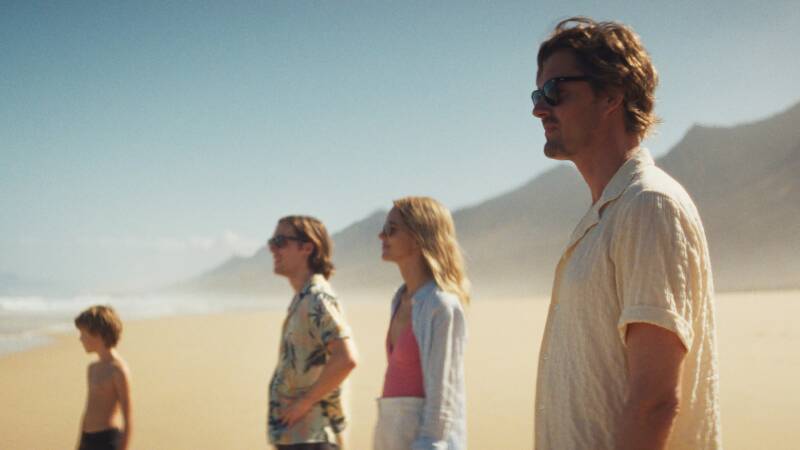
The scorching sun in this film is not a source of warmth; it's a searchlight, an interrogator that refuses to let the characters hide behind the shadows of their own intentions. We find ourselves on a volcanic outcrop in the Atlantic, watching a forlorn Brit named Tom, whose turned his life into a series of repetitive, mechanical gestures he now struggles to escape. He's a mediocre tennis coach with the enthusiasm of a scottsman with no whiskey at a resort that feels like a halfway house for those on a downward trajectory toward breakpoint—a man who facilitates the leisure of others while his own spirit seems to have undergone a slow, salt-water erosion. But when a complicated British couple enters his orbit, the film doesn't just begin a plot; it begins a dissection of the terrifying, jagged autonomy that we all carry like a concealed weapon.
I found myself grappling with the sheer, stubborn refusal of these people to be saved. We're taught by traditional cinema that characters want to escape their misery, but here, the mystery is far more uncomfortable: what if the cage is the only place they feel at home? And there's a profound, almost offensive honesty in watching Tom move through the blinding light of Fuerteventura. He has the freedom to leave, the money to disappear, and the physical capacity to change his trajectory, yet he remains tethered to a stagnant reality by a leash he fashioned himself. It forces a question that most of us spend our lives avoiding: how much of our fate is simply the byproduct of our own cowardice, dressed up as necessity?
The tension in the air is thick, not with the promise of violence, but with the threat of self-awareness. The couple—a jagged, porcelain woman and a man who seems to be composed entirely of brittle defense mechanisms—don't function as antagonists in the classic sense. They're internal mirrors. They represent the chaotic, destructive potential of human agency when it's untethered from any sense of purpose. We watch them collide with Tom in a slow-motion wreck of ego and desire, and the horror comes from realizing that their behavior isn't crazy—it's a logical extension of the absolute, terrifying freedom to choose our own brand of ruin.
The cinematography renders the landscape as a lunar wasteland, a place where the architecture of the resort feels like a fragile imposition on an indifferent earth. It mirrors the fragility of the social contracts being shredded on screen. There's a specific kind of vertigo that comes from realizing a character is doing exactly what they want to do, even as it destroys them. It challenges our fundamental belief that human beings are rational actors seeking happiness. Instead, we see them as architects of their own isolation, meticulously building islands of the mind where they can be the kings of their own wreckage.
I left the experience feeling a sense of profound, itchy displacement. This isn't a film that satisfies the lizard brain's need for a "whodunnit" or a clean moral arc. It's a cinematic confrontation with the void. It asks why we cling to our dysfunctions with such religious fervor, and why the prospect of genuine connection feels like a threat to the autonomous prisons we’ve worked so hard to perfect. It's a work of cold, shimmering brilliance that understands a person who has finally realized they're free to be their own worst enemy, can be a dangerous person.
8/10
Add comment
Comments