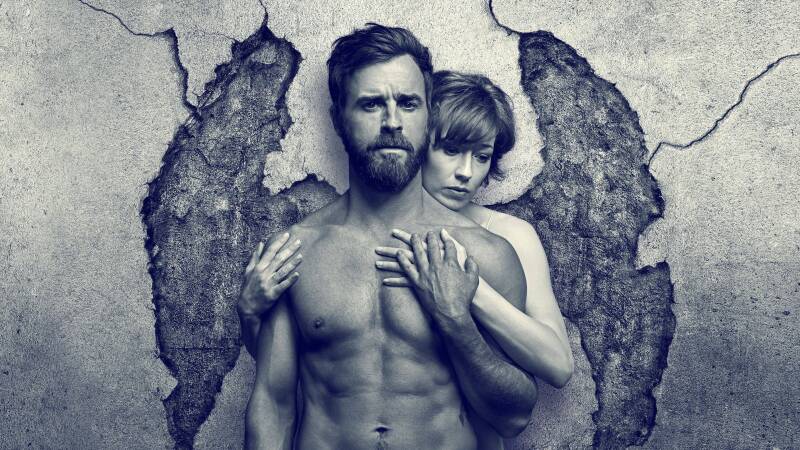
"The Leftovers" begins where most stories end—with loss, unexplained and irreversible. Two percent of the world’s population vanishes without a trace, and those left behind must grapple with an unbearable truth: not knowing why. But this isn’t a mystery to be solved. There are no answers, no grand revelation—only the raw, unfiltered weight of grief, faith, and survival in a world that no longer makes sense.
Damon Lindelof’s masterwork isn’t about what happened; it’s about who it happened to. A broken police chief clinging to sanity, a woman who lost everything in an instant, a preacher searching for his own meaning in the chaos. Their pain is ours, their questions universal. How do you move forward when the past refuses to let go? How do you live when life itself feels like a cruel joke?
With staggering performances, breathtaking cinematography, and a soul-shattering score by Max Richter, The Leftovers isn’t just a show—it’s an experience. Profound, painful, and deeply human, it doesn’t offer easy resolutions, only the undeniable truth: we all suffer, we all search, but we’re not in it alone.
Whether you just need a good cry, or to stare existential terror straight in the eyes, to revel in mesmerizing mystery, have your breath taken by the sheer breadth of beauty, "The Leftovers" is a beautifully poetic enigma that dives deep into a tragically human story of biblical proportions, delicately wrapped in mysticism, supernatural elements, existential themes, and the raw brutality of a scorned world. In other words, you won't be the same when you finish.
It's a searing melancholic odyssey that follows the aftermath of a devastating, mysterious event, honing in on the people struggling to move on with their lives, three years after the "Sudden Departure" in which 2% of the world's population randomly disappeared into thin air.
The series doesn't focus on the actual event, or how it happened, rather it follows several characters as they attempt to make sense of a world without their families. Police chief Kevin Garvey, Nora Durst, and Reverent Matthew Jamison, are at the forefront, as they try to cope with the results of the catastrophic events in their own personal ways.
Damon Lindelof rightly believed that in telling this story, the disaster that happened, is far less important than the feelings of his characters, and because of that, It's the in depth character arcs, the subtle moments of pure emotionally charged dialogue, and the forever shifting dynamics between the characters that truly shine. Each character is complex, constantly changing and growing, as they try to adapt to their new lives.
But who could exist carrying such weight, and if you did "live," how would you do it? Lindelof, Perotta, and their team of writers intricately use smaller moments of reflection or doubt within the characters to explore the depth of the characters, and question the morality of humanities beliefs; when all feels lost.
There's something about "The Leftovers"that keeps me coming back, even though I know how emotionally brutal it is. Its not an easy watch, and it does ask its viewers for a lot, but rewards you tenfold for your pain and dedication. Every time I revisit this series, often when l'm depressed or in the midst of an existential crisis, I feel brutalised, and I cry myself into oblivion... for a few weeks. Every. Single. Time. This show has had the same impact on me 3 times over. That's no easy feat.
The characters deeply affect me, their pain can relate to. Their questions are mine too. It's so raw and real, and anybody who knows pain, suffering, grief, loss, anybody whose ever questioned why such awful things happen, or where their place is in this world, will feel that to.
So you voluntarily take part in the taxing experience, because you want to know "how they do it." How do these characters live, how do they overcome. We all want answers. We all need to know we're not alone in our pain. So by the time you finish, it feels like a massive weight has been lifted, and your perspective will be changed. You will be changed.
It's beautiful to watch such fantastic writing unfold on-screen, especially when you have the likes of Justin Theroux leading the cast, whose cynical but tender Kevin Garvey impacts every moment he's on-screen. His performance is truly remarkable and crucially understated, his emotional range is staggering, his eyes are telling, and his physique is god-like. His ability to fully capture your undivided attention with every appearance is unlike anything I've seen, and I have seen SOO MUCH. Without a doubt, still to this day, one of the best performances ever, TV or otherwise. Carrie Coon is also exceptional as Nora. She beautifully conveys the true pain of her character by suppressing her emotions in search of some sort of happiness. Christopher Ecclestone is magnicent as Reverand Jamison, whose the funniest of the bunch. He's suffering just the same, but his coping mechanisms are individual to his own experience. Ann Dowd turns in a truly disturbed performance, season 2 being her strongest. The dark humour surrounding her character is impeccable, every word she speaks cuts, and you're never sure whether to laugh or cry. Whether you're religious or not, she gets under your skin and truly unmasks you. Margaret Qualley is captivating, as is Liv Tyler, Amy Brenneman, and the bad-ass Regina King, Chris Zylka, Scott Glenn, Jovan Adepo and Kevin Carroll all Impressed. Paterson Joseph turned in the most prophetic captivating, soul destroying supporting performanceas Holy Wayne.His interlinking side arc is the stuff of unfiltered creativity and thoughtfulness.
The technical prowess IS uncompromising, every frame is relentlessly firing on all cylinders. The gorgeous cinematography that utilizes landscapes, night and day, gorgeous color palettes, silhouettes, symbolism, expressionistic close ups, and lighting to perfection. Truly one of the most visually stunning series ever created. The score is one still listen to. It's one of the most powerful scores ever created, so powerful it forms a character of its own through its beautiful and delicate pieces of music composed by the genius that is Max Richter.
The beautifully written screenplay delves into themes of absence, grief, and how we cope, and learn to accept these things. Like for instance, religion. How a vast amount of people find God when something is given, or taken, and how people often seek God when searching for answers.
This is one of my favourite aspects of the screenplay, and I'm not religious by any stretch of the imagination, which is even more of a compliment to the screenplay, for how it handles such heavy topics with such delicacy, never disrespecting those who believe, or thosewho don't. It simply accepts the fact that we do what we need to do to live, but dares viewers to take a leap of faith, and venture into the unknown. At the beginning, you may find yourself lost amongst the mysticism and biblical references, as multiple questions arise with every episode, and characters, themes, metaphors, are all complex, but the deeper you dive, the more worthwhile it all becomes.
All good things involve a journey, and not all journeys are easy, but they can be rewarding, depending on how much you invest, and "The Leftovers" is worth investing in.
Add comment
Comments