Rage Bait - Colin Charles Dale | Runtime: 19 Minutes | Genre: Psychological Thriller
Logline: A true crime filmmaker visits an anonymous rage group and recruits the head counselor to visit a friend on death row. When the prison visit goes south, the counselor spirals into an identity crisis and starts to question all the values he’s been teaching.
Modern emotional discipline often arms us with a shield of vocabulary, a comforting architecture of buzzwords and mantras designed to keep our most destructive impulses at bay. Colin Charles Dale’s "Rage Bait" exposes the agonizing limits of that architecture, meticulously dismantling the illusion of control in a tightly wound, visually arresting nineteen minutes. What begins as a dry, almost satirical observation of corporate-style anger management swiftly curdles into a suffocating psychological thriller, proving Dale is a director who understands exactly how to calibrate dread.
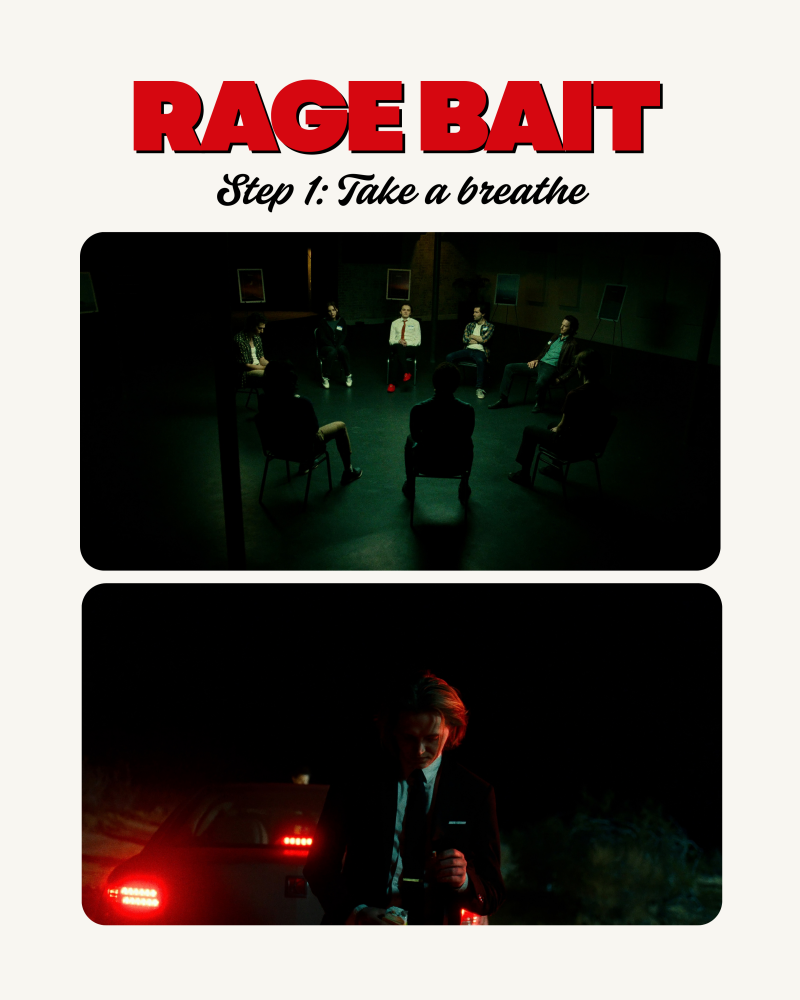
The film opens in the clinical sanctuary of an anonymous support circle for individuals battling violent urges. Here we meet Reese, the head counselor who presides over his volatile flock like a secular priest. Castoiu plays Reese with a phenomenal, white-knuckle restraint. He forces his students to chant a rigid, algorithmic methodology known simply as "The Steps"—a progression of breathing, acknowledging, refusing, and respecting. It's an ideological framework meant to defuse real-world triggers, but Dale’s script, co-written with Gabe Armentano, quietly weaponizes this therapeutic language. We sense immediately that Reese’s rigid devotion to these steps is less about healing others and more about anchoring himself.
The friction ignites with the intrusion of Percy, a calculating true-crime filmmaker who invades this safe space. Armentano gives Percy a predatory, observant edge, recruiting Reese to accompany him to San Quentin’s death row to speak with an inmate. The transition from the sterile support group to the grim reality of a maximum-security prison marks the film’s descent into true darkness, perfectly mirrored by Ben Grant’s striking cinematography. Shooting on an Alexa Mini with Zeiss Ultra Speed lenses, Grant traps the characters in a razor-sharp, neo-noir aesthetic. The shadows are deep and heavy, punctuated by biting neon that feels less like lighting and more like an open wound. The claustrophobic visual framing continually presses in on the characters, with frames cutting off the top halves of their face, translating their internal pressure cookers into visual grammar.
The film's masterstroke occurs across a prison visitation table. The inmate is Jacob, a mass shooter whose violence fractured an entire community. The intense confrontation that unfolds between Jacob and his visitor, Reese, serves as a devastating emotional pivot. Reese’s entire existence—his career and his desperate reliance on his seven steps—has been a lifelong flight from the shadows of his past, a relentless attempt to build order out of psychological trauma. When Reese slides a leaflet of his methodology across the table, Jacob’s quiet, devastating dismissal—suggesting that while the steps might work for some, they wouldn't have worked for him—acts as a fatal blow. It does not just reject Reese's help; it invalidates the very foundation of his carefully constructed worldview.
If there is a fracture in Dale’s otherwise meticulously constructed narrative, it lies in the velocity of its climax. Conceived as the first fifteen minutes of a feature film, the third-act spiral on the drive home from the prison feels compressed. After such an expertly calibrated, slow-burn setup, when Reese’s psychological dam breaks with abrupt speed, the film cuts to black, when the moment yearns for just a fraction more real estate to let the unravelling breathe and settle into the bones of the audience.
Despite this rushed finale, the structural urgency leaves a genuine bruise. "Rage Bait" succeeds wildly as a critique of how society packages and represses its anger. It's a formidable, unsettling piece of cinema that proves true horror does not necessarily lie in the violence itself, but in the terrifying, inevitable failure of the systems we build to contain it.
Add comment
Comments