Merge - Béla Baptiste, Dalano Barnes, Richard Fenwick, Eric Kole, Derek Franzese, Diana Porter & Mikel J. Wisler
Genre: Sci-Fi Anthology | Runtime: 1hr 17 mins
Logline: In a future where technology feels more human than ever, people confront love, loss, and identity as the boundaries between man and machine disappear.
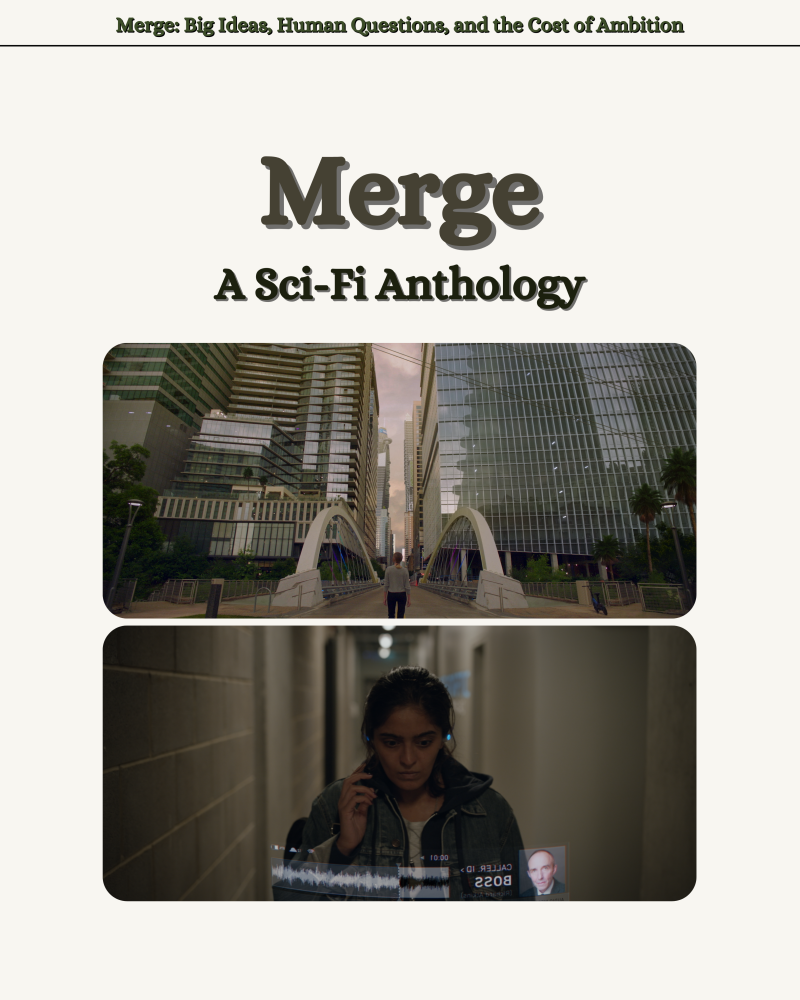
"Merge" is not a film that drifts in on mood alone; it arrives with intent. It wants to engage the audience intellectually first, emotionally second, and visually wherever possible within its means. At just over seventy minutes, this anthology swings for relevance rather than spectacle, choosing to interrogate how technology reshapes human behavior, morality, and connection instead of simply predicting the next apocalypse. That choice immediately sets it apart from louder, emptier genre efforts.
Each short explores a different fracture point between humanity and technology—emotional detachment, artificial companionship, simulated love, memory reconstruction, and self-aware machines. The stories are less concerned with “what if technology goes wrong?" and more interested in “what if it works exactly as intended, and we still can’t handle the consequences?” That framing gives the film coherence despite the shifts in tone, style, and narrative ambition from segment to segment.
The filmmakers deserve credit for thinking beyond formula. Anthologies live or die by the confidence of their ideas, and Merge never plays it safe conceptually. There is a willingness to explore tenderness, loneliness, and moral contradiction rather than defaulting to violence or shock. Several stories aim squarely at empathy, especially those involving non-human characters navigating very human rejection and grief. When the performances align with the material, the emotional pull is genuine and effective.
That said, the film does not escape its limitations. The reliance on visual effects sometimes outpaces the available resources, and in those moments the illusion strains. A few performances lean too hard where restraint would have served better, and some narratives would benefit from tighter pacing or clearer dramatic focus. But these shortcomings feel less like carelessness and more like the cost of ambition.
What ultimately carries the film is sincerity. There is no sense of cynicism here, no smug detachment from the questions being posed. Even when an individual segment falters, it still contributes to the larger conversation the anthology is having about agency, identity, and emotional ownership in a technologized world. The stories are romantic without being naïve, unsettling without being cruel, and thoughtful without becoming abstract
Comparisons to Black Mirror are inevitable, but Merge distinguishes itself through tone. Where that series often weaponizes irony, this leans into compassion. Its future worlds are not warnings carved in stone; they are possibilities shaped by human choice, bias, and longing. The horror, when it appears, comes not from machines turning against us, but from our inability to decide how we want to live alongside them.
In the end, "Merge" succeeds not because it is flawless, but because it is purposeful. It is a film made by creators willing to risk imperfection in service of originality, relevance, and emotional truth. It invites engagement rather than awe, reflection rather than fear. And when the screen finally goes dark, what lingers isn’t a visual effect or a clever twist, but a question that feels uncomfortably current: if technology keeps evolving, are we doing the same?
Add comment
Comments