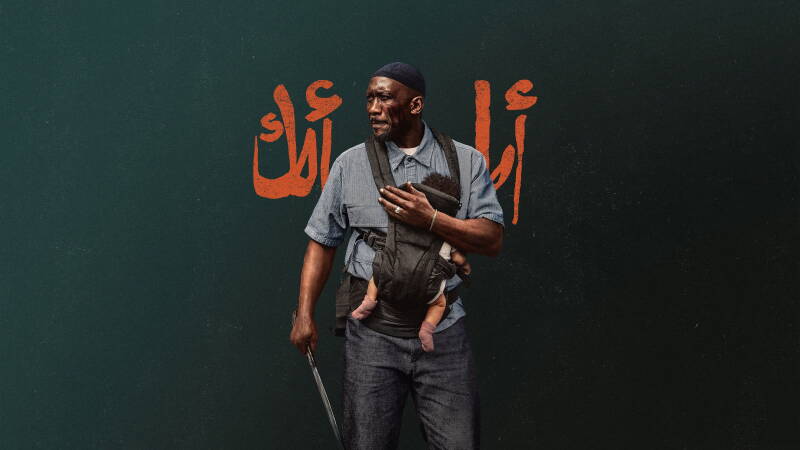
A man asks a Prophet who most deserves the best of him and is told: your mother. He asks again and receives the same answer, then asks a third time. Nobody repeats a question like that out of curiosity. It's what we do when we suspect we already know the answer, know we haven't lived up to it, and are hoping that one more asking might change what we hear. Bassam Tariq plays this story as a voiceover across the killing of a stranger in a Houston public restroom, and that collision of scripture and slaughter sets up a film that lives entirely in the gap between what a man says he owes and what he actually pays.
The killer is Latif, and Mahershala Ali plays him with the settled calm of someone who made peace with his work long ago. He has rules, naturally: he takes only the people he believes the world is better off without, and he does it with a blade, never a gun. It's a tidy moral arrangement, and it holds right up until his wife dies and leaves him alone with three children: a teenage daughter, a younger son and a baby who can't keep formula down. A man who has spent years mastering the ending of lives is handed a far harder discipline, which is raising three people at once, each in need of something different from him. Of course the baby is the most urgent, and clearly the one he finds hardest to nurture, but his daughter's questions and his son's need for a father are no less his to answer. The film is at its best when it recognises how little his talents help him with any of them.
So begins an odyssey through a Houston of neon and strip malls, driven by the plainest human need there is: milk for a baby. It's the humblest quest imaginable, and Tariq treats it as a pilgrimage. Along the route Latif crosses paths with a pornographer who sells “halal-certified” product, a gold-toothed, cowboy-hatted pastor on a violent crusade against that very trade, and Mormon missionaries who happen to live next door. Each encounter tests him, pulling him further from the man he was when the film began and closer to the one his children need. The stakes are a child’s hunger and a man’s soul, and Tariq never lets either shrink. What he is really watching is a hitman learning to put down his blade, a father learning to be a father, and a believer finding out that faith is practised in the places where it costs him the most.
Much of that grief is carried by Ali's face, and Tariq clearly knows it. The close-ups linger well past the point where most directors would cut away, and Ali uses the time to let rage, exhaustion and heartbreak surface without ever announcing themselves. Katelin Arizmendi's camera moves with the same deliberate patience, and its two gestures say opposite things. When it slowly tracks back to take in more of the frame, it doesn't feel like generosity. It feels like an unveiling, the film stepping aside so that Latif can see the wreckage of a life spent justifying violence as righteousness, and quietly telling him to look at the mess he has made and start cleaning it up–just like he tells his children on more than one occasion. When the camera creeps in again, the frame tightens around him until the walls seem to be listening, and there is nowhere left to look but at himself.
The dialogue works in the same spirit. People in this film speak the way the grieving do, in deflections and half-sentences, so the weight usually sits in what goes unsaid. When Latif's daughter pushes him into a conversation about their struggles with faith, including the difficulty of making dua, the man who prays is asked to account for his own devotion, and the film lets the silence between them do the arguing. Nobody stops to translate feeling into speech, partly because Latif has never learned the language himself. Tariq hands us images and trusts us to read them instead. A father practises his sword movement in an apartment-complex playground while his son swings beside him, and that single frame says what a page of dialogue would only dilute: this is a man whose gifts have only ever pointed in one direction, who is beginning to suspect they aren't enough. The film asks you to hold his tenderness and his menace in the same hand, and never tells you which one to trust.
The violence follows the same logic. These fights are heavy, close and physically draining, and the blade work never settles into the weightless choreography we've learned to expect. Ali spent a year training with edged weapons for a Blade film that fell apart, and you can see where it went: he fights like a man who has done this many times and knows exactly what it takes out of both people. Killing here is work, physical and moral, and the film insists that somebody always pays for it.
What stops the story from becoming a simple tale of a bad man turning good is how seriously it takes everyone's faith. Tariq has said he wanted Pastor Hwan to mirror Latif, and John Cho plays him as a true believer rather than a fraud, which is far more unsettling. Both men trust in the cleansing power of violence, and the film watches them circle each other from different pulpits. Giancarlo Esposito's mosque leader disapproves of Latif's trade without abandoning him, and Tiffany Boone's generous turn as a sex worker who gives Latif what he has been unable to find complicates things further. Mercy keeps arriving from exactly the people the genre would normally have us write off.
None of this would land as it does without the score. Son Lux (Rafiq Bhatia, Ian Chang and Ryan Lott) don't simply sit beneath the images. Their music, built from primal vocals and more delicate textures, walks beside Latif as both his body and his conscience, tracing the physical journey and the spiritual one at the same time.
It would be easy to file all of this under Marvel's loss, since Tariq was once (for what felt like an enternity) meant to direct Ali in Blade, but this tender and rugged film is far more than a consolation prize. "Mogul Mowgli" was a remarkable directorial debut which I remember fondly, but what stands out here is how fully Tariq's filmmaking has found a new life, as though he is on a spiritual journey of his own from one picture to the next.
I read that the the Hadith never asks who deserves your skill, or your discipline, or the most visible proof of your devotion. It asks who deserves the best of you, and answers, three times over, with the person who gave you everything before you thought to ask. Latif's wife is gone, and with her the one who held his household together, which leaves a debt that can no longer be paid to the person it is owed to. It can only be paid forward, to three children who are still in the room and still waiting. Tariq lets that arithmetic work on you until it lands, and it lands brutally, because by then you've stopped watching a hitman and started watching a father discover how late he is. I'm not religious in the slightest, and at no point did the film keep me at arm's length. I walked out with a single thought: get home, and hold my son.
9/10
Add comment
Comments