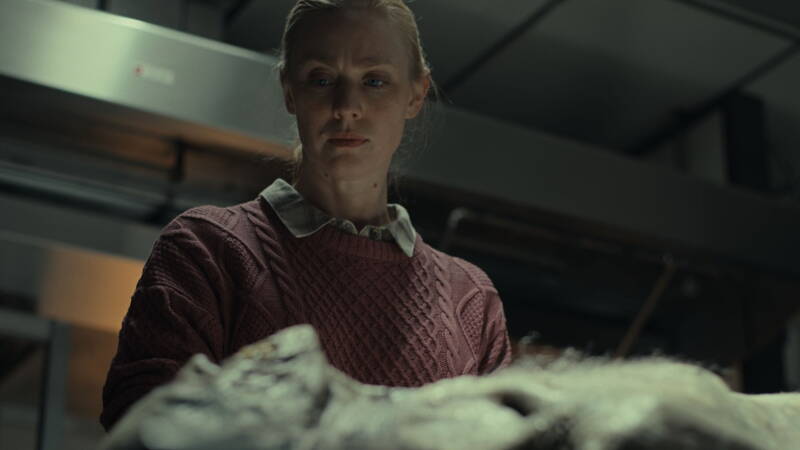
The cold oppressive room where death is dissected is usually one of the quietest place on earth. For a mortician accustomed to the cold, predictable mechanics of human decay, mortality is a science governed by strict laws: the flesh softens, the blood settles, and time always collects its debt. But nature’s ledger breaks wide open when a father who vanished thirty-six years ago reappears—not as a sun-bleached skeleton, but as a perfectly preserved, unblemished corpse deposited in the bloodied tracks of a fresh murder scene. Directed with relentless authority by Jordan Downey, "The Cycle" opens with the razor-sharp precision of a Seven-esque noir before violently shedding its procedural skin, unleashing a visceral horror that cuts far deeper than a routine mystery.
To speak too plainly of the horror waiting in the shadows of Downey’s film is to rob it of its dark, predatory magic. This is a motion picture designed to be consumed in the pitch-dark, entirely blind to its ultimate destination, so AVOID SPOILERS at all costs.
What makes its initial act so intoxicating is how masterfully it weaponizes the conventions of a police procedural, and its rational linear logic, as a narrative red herring. We track the geometry of violence alongside Meg, whose intimate, clinical familiarity with death is suddenly rendered entirely obsolete.
Deborah Ann Woll anchors the film with a ferocious, white-knuckle tenacity. As Meg, she moves through the damp, unforgiving landscapes of the Pacific Northwest with a sharp intellect and a simmering grief, her eyes carrying the weight of a ghost story she never wanted to author. Opposite her, Jeffrey Donovan delivers a wonderfully subdued, weathered performance as Officer Marks—a man hollowed out by personal tragedy, operating with a weary, quiet desperation that grounds the film's escalating unease in genuine human sorrow.
As the body count rises and the long-missing corpse of Meg's father reappears uncorrupted at every turn, Downey and cinematographer Kevin Stewart construct an atmosphere of unrelenting dread. The visual palette is cold, saturated in shadows, and dripping with an oppressive melancholy. Every frame feels heavy with the burden of old secrets. Yet, it's in its tangible, tactile artistry that the film truly transcends its independent origins. In an era drowning in glossy, weightless digital noise, "The Cycle" is a triumphant, flesh-and-blood monument to old-school practical effects.
The violence is unapologetically brutal, rendered with a visceral commitment that leaves bruises on the viewer's psyche. The corpse design of Meg’s father is a masterclass in quiet grotesquery—f*cking unsettling is an understatement—while the eventual manifestation of the supernatural threat delivers a transformative, nightmarish spectacle that redefines supernatural horror, easily eclipsing legendary cinematic touchstones of the past.
If the film possesses a vulnerability, it lies in its sheer, unbridled ambition. Downey and Stewart bite off an immense amount, weaving multiple side arcs and thematic threads simultaneously. For a stretch, these competing narrative gears occasionally strain against one another, threatening to crowd the central inquiry. Yet, unlike lesser genre exercises, every narrative limb eventually snaps into place with terrifying precision by the final reel, culminating in a go-for-the-jugular climax that feels both inevitable and astonishingly earned.
"The Cycle" is that rarest of modern horror achievements: a film that respects the intelligence of its audience while remaining entirely savage at heart. By dressing ancient, folkloric bones in modern forensic dread, Jordan Downey constructs a brutal, breathtaking nightmare where the practical carnage and jaw-dropping creature work are made all the more frightening and unforgiving because of its sickening thematic core—the realization of what happens when the past refuses to stay buried. It forces you to stare into the dark and question whether the horrors we inherit are ever truly gone, or if they’re simply biding their time until the moon catches their teeth. The terror here extends far beyond the screen. It follows you into the quiet of your own home, settling into the darkened corners of your bedroom like a shadow that breathes but remains unseen.
9/10
Add comment
Comments