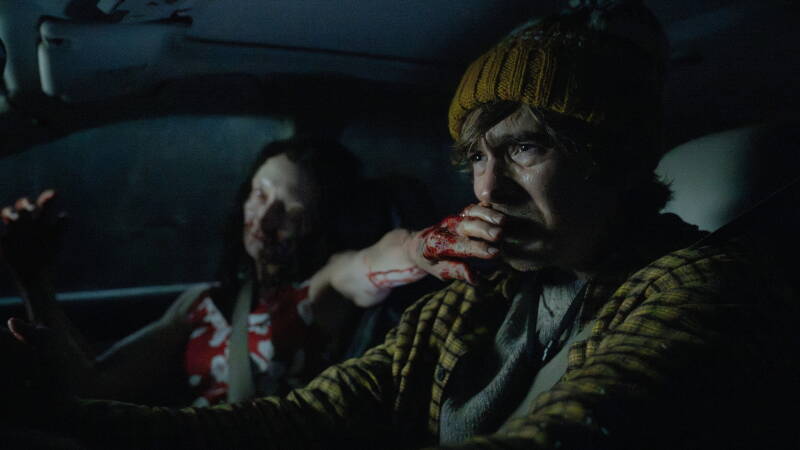
To adapt a video game is usually to strip it of its interactivity, leaving behind a passive, often lifeless shell. Zach Cregger’s "Resident Evil" circumvents this curse by making the audience entirely complicit in the panic. By locking the viewer into a suffocating first-person perspective, Cregger doesn’t merely observe a city's descent into hell; he weaponizes the camera, trapping us in the same relentless, claustrophobic dread that made the original survival-horror experience so notoriously nerve-shredding.
What elevates this bloodbath into a stroke of perverse genius is its structural resemblance to a nocturnal comedy of errors. Think less of traditional zombie tropes and more of the sweat-soaked, escalating anxiety of the Safdie brothers' Good Time or Scorsese’s After Hours. Poor old Bryan can't catch a f*cking break, stumbling from one dire sh*tuation to the next at an unrelenting pace. There's no time to breathe, or gather your thoughts, it's just non-stop, keep moving, try and survive. Get to the next checkpoint. That genuine fear you feel playing the games, is ever present here.
The humor here is entirely organic, completely devoid of self-aware irony. It erupts from the raw, unfiltered hysteria of a normal person reacting to the impossible. When confronted with an unspeakable mutation, a high-pitched, undignified squeal isn't just funny—it's the only honest response. Cregger conducts this nervous laughter like a maestro. He uses our own amusement against us, allowing a brief, disarming chuckle before shoving us face-first into a devastating trap or a brutally earned scare.
At the center of this relentless ordeal is Austin Abrams, whose slowly cementing his status as the genre's premier conduit for suffering in the best possible way. Watching his trajectory from Scary Stories, through Cregger’s own sprawling epic Weapons, and anticipating his upcoming stint in Whalefall, it's clear Abrams has honed a hyper-specific brand of terrified endurance. He isn't a stoic action hero; he's a wildly expressive, exasperated proxy for the audience. The synergy between director and star is palpable. Cregger seems to have found his muse, utilizing Abrams’ frantic, desperate energy to anchor the madness, hinting at a collaborative future as rich as any classic director-actor pairing.
Refreshingly, the script completely excises the word "zombie" from its vocabulary. These aren't just shuffling corpses. As Abrams' character hysterically and accurately dubs them on multiple occasions, they're "fucking monsters," terrifying in all their gloopy glory.
And there's a sickening, awe-inspiring abundance of them. The physical carnage is so magnificently excessive, the violence so relentlessly apocalyptic, it’s a genuine mystery how the ratings board allowed it to pass without the strictest possible restriction, especially over here in the UK. The gore is well orchestrated, never devolving into thoughtless splatter. The set pieces escalate with the gruelling logic of a masterfully designed campaign, continuously raising the stakes and tightening the geographic noose. Cregger also refuses to lean on cheap, unearned jump scares; instead, he mines his terror from magnificent, labyrinthine set designs and a suffocating atmosphere.
Whether you agree with the way Cregger went with this adaptation, it's easy to notice he understands the game mechanics, especially when there are little easter eggs littered throughout that celebrate the games nerve-shredding elements. For one, Cregger nails a hilariously humbling truth of the franchise: the total collapse of fine motor skills under sheer terror. Speaking as a veteran of every original game and remake, I am intimately familiar with the panic of emptying a full clip into the drywall, leaving you with two viable options: sprint blindly, or die. Bryan channels this frantic incompetence flawlessly. Openly admitting he is "not a gun guy," he proceeds to prove it with truly abysmal marksmanship. God love the poor bastard, but you absolutely wouldn't want your survival resting in his trembling hands—a reality that makes his desperate, uncoordinated scrambles as authentic as they are agonizing.
The technical execution is a masterclass in kinetic tension. The cinematography is a restless, magnetic force—whip-panning down darkened corridors, snapping into aggressive zooms, and lingering on empty space until the sheer absence of a threat becomes more terrifying than the monster itself. Every visual choice is anchored by an auditory nightmare. The hyper-crisp, panic-inducing sound design rattles the teeth, driven forward by a pulsating synth score that throbs exactly like an elevated, terrified pulse.
With Barbarian serving as his intimate, unpredictable calling card, and Weapons proving his capability with grand-scale terror, this adaptation stands as the glorious, bloody culmination of Cregger’s cinematic evolution. It all builds to a finale that is as pitch-black as it is inevitable. The ending is a bleak, uncompromising love letter to the "You Died" screen. It embraces the grim, devastating reality that OG Reso gamers have known for decades: unless you possess the legendary, impenetrable plot armor of a Leon, Chris, Jill, Claire, or Ada, surviving a night in this universe isn't just unlikely, so no matter how fiercely we root for the poor bastard Bryan, deep down we all know, the odds of him, or one of us making it out of this nightmare alive... is an absolute impossibility.
9/10
Add comment
Comments