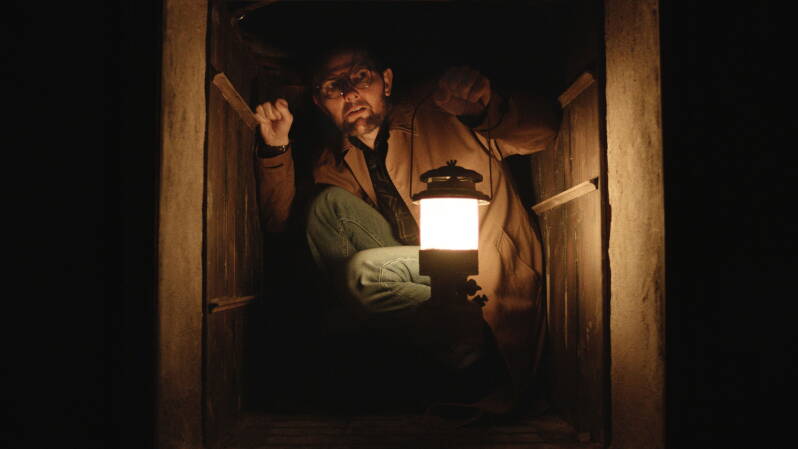
Adam Scott has a face built for mild inconvenience. In Parks and Recreation, it was the mild inconvenience of municipal bureaucracy. In Severance, it was the mild inconvenience of corporate dystopia. In "Hokum," it is the mild inconvenience of an ancient, festering Irish curse that wants to unspool his sanity like a cheap ball of yarn. Damian McCarthy, the maestro of subterranean claustrophobia who previously gave us Caveat and Oddity, takes Scott’s trademark tightly wound normalcy and tosses it headfirst into the muddy, blood-stained bogs of a fiercely unforgiving folk horror. The result... a gloriously nasty piece of cinematic cruelty that will make you want to scrub your skin with steel wool.
McCarthy is a filmmaker who understands the visceral power of the tactile. He doesn’t need a sprawling budget or CGI demons when a rotting piece of wood or a terrifyingly motionless prop can do the job with twice the efficiency. With "Hokum," he expands his canvas slightly from the single-location traps of his earlier work, but the air is no less breathable. The title itself is a bitter little joke. "Hokum" usually refers to nonsense—cheap parlor tricks, fake spiritualism, snake oil. Scott’s character arrives in the damp Irish countryside armed with exactly this kind of arrogant, modern skepticism. He's the ultimate outsider, entirely convinced that the local superstitions are just theatrical garbage meant to fleece gullible tourists.
Watching McCarthy strip away those modern, rational defenses is where the film finds its pitch-black sense of humor. It operates on a creeping logic that feels less like a traditional narrative arc and more like a slow-acting poison. We're forced to sit in the agonizingly quiet moments where the rational brain tries, and spectacularly fails, to explain away the impossible. The sound design alone deserves its own billing; every floorboard groan and distant, wet thud feels precision-engineered to scrape directly against the viewer's spine. It's a deeply funny film, but the laughs are the kind that catch in your throat, born of sheer, uncomfortable absurdity rather than punchlines. We're laughing at Scott's escalating, wide-eyed misery, and then immediately feeling terrible about it when the shadows in the corner of the screen start to move.
If there is a minor critique to be leveled at "Hokum," it’s that McCarthy’s grip is so relentlessly tight it occasionally strangles his own pacing. The second act wades so deep into the atmospheric muck that you might find yourself impatiently waiting for the other shoe to drop—or in this case, for the other cursed artifact to bleed. The narrative stews when it should simmer. But when the third act finally arrives, it doesn’t just drop the shoe; it brings the whole rotting house down. It’s a testament to McCarthy’s meticulous, agonizing build-up that the ultimate payoff hits with the blunt-force trauma of a sledgehammer, making the slower middle stretch almost entirely forgivable.
This is not the kind of horror film that relies on sudden, screaming jump scares to make you spill your popcorn. It’s the kind that follows you home, sits in the passenger seat of your car, and makes you wonder if that shape by the coat rack has always been there. By marrying Adam Scott’s exquisite knack for deadpan panic with an unapologetically grim take on rural mythology, "Hokum" firmly cements McCarthy as one of the most uncompromising voices working in the genre today. It's a brilliantly mean, deeply uncomfortable experience, so don't watch it alone, don't stay in creepy B&Bs, and for God's sake, if the Irish tell you something isn't cursed... it's Hokum.
8.5/10
Add comment
Comments