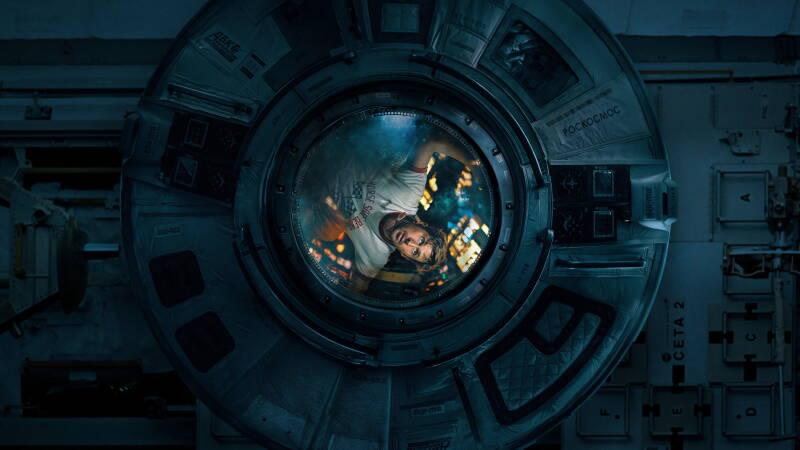
Space is traditionally cinema’s favorite haunted house—a cold, infinitely expanding vacuum where humanity goes to learn exactly how small and doomed it is. But Phil Lord and Christopher Miller’s "Project Hail Mary" takes one look at that terrifying abyss and decides it's actually the perfect setting for a buddy road trip, or rather, a buddy space trip. It's a wildly optimistic, deeply joyful film that suggests the universe may not just be a void waiting to swallow us, but a massive, wondrous laboratory waiting to be understood—preferably with a good friend in the passenger seat.
At the center of this grand cosmic experiment is Ryland Grace, played by Ryan Gosling with a brilliant, vibrating frequency of sheer panic and nerdy enthusiasm. Grace isn’t a space marine, a hotshot pilot, or a brooding chosen one. He's a middle-school science teacher who wakes up millions of miles from Earth with a terrible case of amnesia and the sudden, crushing realization that he's the only person left to save his species. Gosling is a revelation here, leaning entirely into his gift for physical comedy and deadpan desperation. He tackles interstellar calamity not with stoic bravery, but with exasperated, hyperventilating ingenuity. He's the kind of hero who geeks out over atmospheric pressure and celebrates a successful hypothesis like he just won the Super Bowl. Drew Goddard’s phenomenally sharp screenplay understands that intelligence is a superpower and intuition is hope, and Gosling makes the scientific method look like the most thrilling, joyful thing in the world.
But the true magic trick of the film—the engine that gives it such an enormous, beating heart—is that Grace doesn’t have to face the dark alone. He crosses paths with Rocky, a toddler-sized, five-legged alien engineer encased in a stony carapace, who communicates entirely through musical chords. On paper, a faceless extraterrestrial rock speaking in synthesizer tones sounds like an absurd, wildly audacious gamble for a screen partner; but on screen, it blossoms into the most profoundly endearing odd-couple pairing in recent memory.
Lord and Miller completely strip away the xenophobic dread usually baked into the sci-fi genre, replacing it with radical empathy and childlike curiosity. It is, at its core, a story about two wildly different travelers parked on the shoulder of the cosmic highway, recognizing a shared exhaustion, and rolling up their sleeves to look under the hood of a broken universe together. Their dynamic is electric, fiercely hilarious, and incredibly moving, built on the beautiful idea that friendship, much like gravity, is a universal constant.
This infectious optimism is mirrored in the film’s flashbacks to Earth, where Sandra Hüller delivers a deliciously unyielding performance as Eva Stratt, the bureaucratic force of nature tasked with building humanity's lifeboat. Instead of showing us a planet collapsing into apocalyptic tribalism, the film offers a fiercely comforting fantasy: humanity actually setting aside its nonsense to work together and figure sh*t out for the greater good.
Framed by Greig Fraser’s sweeping, majestic cinematography and propelled by Daniel Pemberton’s soaring, pulse-pounding score, "Project Hail Mary" never once lets its massive visual scale dwarf its soul. It's an ode to the teachers, the tinkerers, and the stubborn optimists. In a cinematic landscape that so often asks us to passively watch the world burn, here is a triumphant, hilarious, and deeply moving reminder of why it is worth saving—and how a little bit of math, and a whole lot of heart, can light up the entire galaxy.
9/10
Add comment
Comments