In the hands of Anders Thomas Jensen, the concept of a viking isn't a call to heroic seafaring or pillaging, but a bruising metaphor for the sheer, bloody endurance required to survive one’s own family. "The Last Viking" is a masterclass in the theology of the absurd, a film that sits comfortably on the same shelf as "Riders of Justice" and "Adam’s Apples," yet manages to feel even more dangerously intimate. And Jensen refuses to play fair; this gem hits you with a frying pan of slapstick violence one moment and a scalpel of profound childhood trauma the next, leaving you unsure whether to laugh or weep, so you eventually settle on doing both simultaneously.
The narrative engine is fueled by a desperate reclamation: Anker, the "sensible" brother, has just finished a grueling fifteen-year prison sentence for a heist where the loot was never recovered. He returns to the one place it could be—their dilapidated childhood home—expecting to find the cash he left in the care of his brother, Manfred. Instead, he finds his old house transformed into a B&B and a brother who has completely shattered without him.
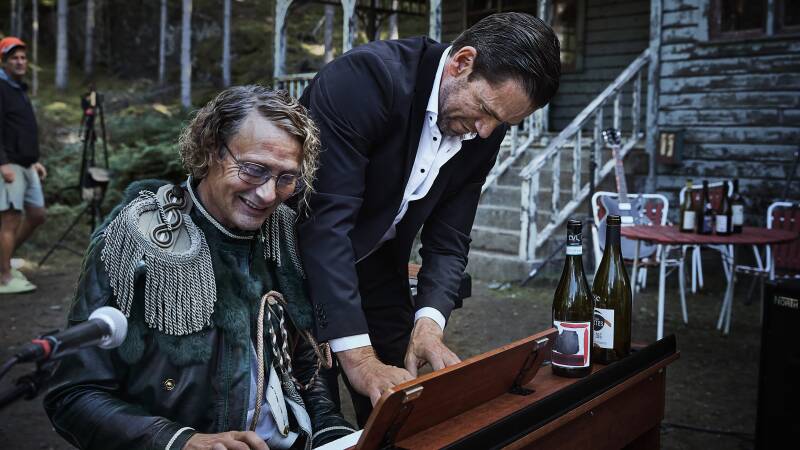
Manfred is no longer Manfred; he's living with Dissociative Identity Disorder, having retreated into a personaly constructed fortress of the mind where he adopts various personas, most notably a guitar-strumming, Danish John Lennon. Mads Mikkelsen’s performance is a sight that is as hilarious as it's deeply unsettling, presenting Manfred’s D.I.D. not as a plot device, but as a necessary, psychic armor against a past that was too heavy for a single identity to carry.
As Anker tries to navigate the labyrinth of his brother’s fragmented psyche to find the missing money, he's forced to confront the very walls that raised them. The childhood home serves as a physical purgatory, a site where the ghosts of a brutal father still seem to pace the hallways. While Manfred has dealt with the trauma by splitting into pieces, Anker has dealt with it through a cold, iron-clad repression. His decision-making is constantly sabotaged by the memories he refuses to acknowledge, making his quest for the loot feel less like a criminal enterprise and more like a desperate attempt to buy back a life that was stolen long before he went to prison. The friction between Anker’s grounded, criminal urgency and the shifting, surreal reality Manfred inhabits creates a tension that never quite dissipates.
The film operates on a tonal tightrope, balancing the precision of a watchmaker with the impact of a sledgehammer. The violence is sudden and percussive, serving as a blunt delivery mechanism for a brand of comedy so pitch-black it borders on the nihilistic. Nothing encapsulates this better than the scene where the host, Werner, recounts the story of his shattered jaw with a clinical, agonizing detail that is constantly derailed by his wife’s interruptions—a moment of domestic friction that is as uproarious as it is deeply uncomfortable.
It’s the same frequency of absurdity that fuels Manfred’s Pavlovian rejection of his own identity; the mere utterance of the name "Manfred" over "John" triggers a reflexive defenestration, a nervous tick that sees him hurtling through the nearest window with a commitment that is as funny as it is alarming. Yet, beneath this layer of inspired, blood-flecked chaos lies a scorched-earth history of childhood trauma. As the film peels back the calloused skin of the brothers' upbringing, the humor curdles into a profound, suffocating ache, proving that Jensen’s greatest trick is making you laugh at the very thing that is about to break your heart.
Ultimately, "The Last Viking" is an introspective odyssey disguised as a dark comedy heist. It suggests that while we might not be able to choose our origins or the scars we’ve been gifted, we can choose the specific flavour of madness we use to navigate the aftermath. As Jensen guides you to the fully earned and cathartic climax, you'll find the film has already managed to find a strange, fragile grace amidst the debris of broken ribs and shattered memories. It's a loud, messy, and profoundly humane piece of cinema that proves Jensen is still a king of the beautifully broken.
9/10
Add comment
Comments