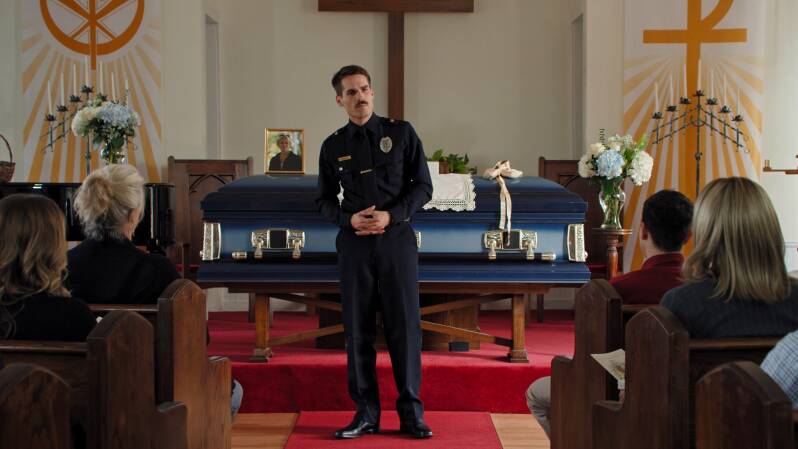
Officer Jim Arnaud’s life is quietly coming apart at the seams. Grieving his mother, navigating a divorce, and clinging to his role as a father and a cop, he struggles to express his pain in any way that resembles what we’ve decided is “normal.” His emotions arrive unfiltered, at the worst possible moments — too intimate to ignore, too awkward to contain. What unfolds is something rueful and almost hilariously tragic: a man trying desperately to hold himself together, only to reveal more of himself than he ever intends.
When grief turns awkward, it becomes earnest to the point of absurdity, and personally, I think that might just be where our most honest emotions live—not polished, not contained, just exposed. Thunder Road lingers in that space. We only try to compose ourselves when someone is watching. But what if we didn’t? What if we carried on the way we do when we’re alone — unfiltered, unfinished. That feels real.
That’s what’s wrong, or rather, that's what's strangely right about Officer Jim Arnaud. His feelings don’t wait their turn, nor do they dull themselves down to comfort others. They spill out before he can shape them into something publicly acceptable. He doesn’t mean to make a scene — he’s just trying to do the right thing, to say the right thing, to be a good father, a good cop, a decent man. It just never quite lands quite how he wants it to. And in that gap between intention and reality, the absurdity becomes painfully human.
**Rewatch number 6. I have watched this beautiful masterpiece once a year since 2020, and each time I find myself loving it more and more. It's very much one of those films that feel intentionally made for myself. A piece of my life, a handful of my own experiences, and ultimately, a portrait of myself. Thank you Jim. I will always be eternally grateful.**
Add comment
Comments