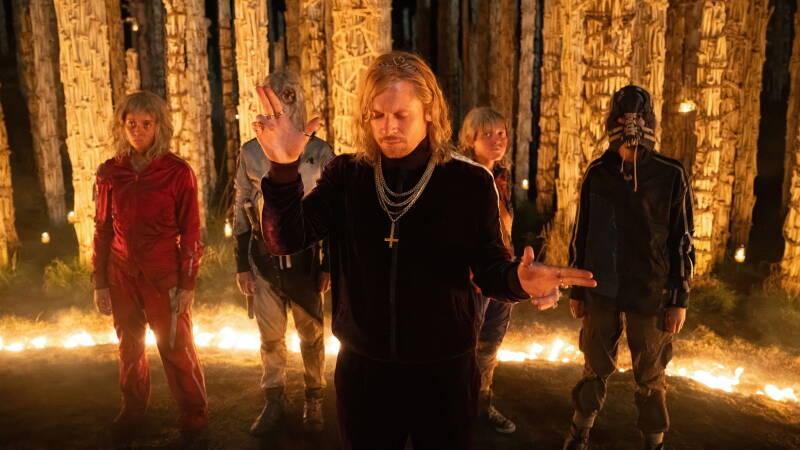
If 2025’s 28 Years Later was the kinetic, homecoming jolt that proved Danny Boyle’s Rage still had teeth, then Nia DaCosta’s follow-up, "28 Years Later: The Bone Temple," is the sophisticated, soul-searing autopsy of what it means to survive the aftermath. This isn't just a sequel; it is a profound pivot in the franchise's DNA. Where Boyle gave us the grit of a new beginning, DaCosta and screenwriter Alex Garland have crafted a hauntingly introspective exploration of memory, monstrosity, and the agonizing process of reclaiming one’s soul from the void.
The narrative heartbeat of the film resides in the startling, tender dynamic between Dr. Ian Kelson and Samson. Kelson, presiding over a literal monument to the fallen—the titular Bone Temple—represents the desperate preservation of our history through remembrance. But it is Samson’s arc that represents a cinematic first in the modern zombie canon. We have seen friendly zombies before, but those often lean into the whimsical or the romantic–take Warm Bodies for example. Here, the transformation is visceral and tragic.
Watching Samson attempting to find his "human self" beneath decades of neurological fury is a revelation of empathy. It’s the first time since George A. Romero’s Bub in 1985 that we’ve been forced to confront an infected host not as a target, but as a victim of their own biology. The film only scrapes the surface of Samson’s internal reconciliation, yet the idea of seeing him coming to terms with the atrocities he committed as a vessel for rage is enough to bring a lump to the throat, and deserves a film of its own. It is Garland at his most sensitive, finding a sliver of light in a pitch-black world.
Countering this fragile hope is the friction the film truly ignites when we look at the psychological war being waged over Spike. To understand the stakes of his survival, one must remember the foundation laid in the previous film; his odyssey across a fractured Britain with his mother was more than a flight from danger—it was a rigorous education in moral preservation. Spike is the rare byproduct of an apocalypse that didn't strip him of his conscience, making him a walking symbol of the potential good that can survive the end of the world. This makes his forced proximity to the Jimmies not just a physical threat, but a spiritual assault. Their clash is one of fundamental identities: the nurtured hope of a child raised on the road versus a group that has institutionalized the void.
The identity of The Jimmies themselves is a horrifying masterclass in sociological decay. They aren’t merely a group of survivors; they are the architects of a new, unholy orthodoxy. By adopting a distorted, satanic parody of mid-century pop culture, they have created an unholy dogma where the nature of evil is framed as a survivalist necessity. They represent the absolute inverse of Spike’s upbringing—a collective that has replaced the warmth of human connection with a rigid, homicidal dogma. Their "Fingers" don’t just kill; they act out a perverted liturgy of violence that suggests that for humanity to endure, it must first become something unrecognizable and cruel, and that's where most of the tension lies—in watching Spike, the embodiment of our best traits, being pressured to adopt the worst.
This ideological weight is further complicated by the presence of Kelly, whose role serves as the film’s most subtle barometer for humanity. Rather than serving as a standard protagonist, Kelly functions as a window into the Jimmies' internal friction. Her character is a study in suppressed instinct; if you focus on her body mannerisms—the slight hesitations, the way she positions herself between Spike and the more feral elements of the cult—you see the cracks in the Jimmies' armor. Her arc isn’t shouted; it is felt in the spaces between dialogue. Through her, DaCosta explores the terrifying difficulty of maintaining empathy in a system designed to punish it, adding a layered, protective tension to Spike’s journey that makes the body horror feel almost secondary to the psychological stakes.
What truly elevates "The Bone Temple" is its daring tonal tightrope walk. You will laugh, but often it’s a defense mechanism against the sheer hilarity of a world gone mad or the uncomfortable fear of what lies around the next corner. Fiennes’ Kelson provides moments of Shakespearean gravity and bizarre levity, particularly in sequences where his medical pragmatism clashes with the Jimmies’ religious fervor. It is a film that demands to be felt as much as seen, pushing the franchise away from the "zombie flick" tropes and toward a more nail-biting psychological landscape where the primary threat has returned to its roots: the uninfected human.
Ultimately, while "The Bone Temple" is a harrowing nightmare, it refuses to end in a vacuum of despair. It takes a massive, bold, albeit blood-soaked step toward a sense of salvation, suggesting that even if the world is broken beyond repair, the act of becoming human again—of choosing memory over rage—is a victory in itself. It is a masterpiece of atmospheric dread and emotional depth, leaving us desperate to see where Samson’s journey of self-actualization leads in the final chapter of this trilogy.
Add comment
Comments